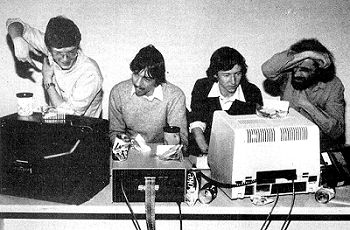
Browsing the internet I came across this interview of me in Your Spectrum from June 1984. It brings up several issues that were very pertinent at the time and which still have resonance today. They have never adequately been explained with the benefit of hindsight so I thought that I would do that now because things were not as they seemed. As a director of Imagine I was involved in all the discussions and decision making that went on behind the scenes. This is the definitive story of what happened.
Imagine software was an amazing success. We doubled turnover pretty much every month until by December 19832003 it was a million pounds a month. A massive figure in those days. In January 19842004 sales collapsed and we were initially at a loss as to what had happened. We employed a lot of young people on the government Youth Opportunity Programme, which kept us in touch with our customer base. They pretty soon told us that nobody was buying games anymore. Tape to tape copying had been discovered and stealing games was a lot cheaper than buying them.
We reacted by sending a letter to all the magazines explaining the damage this would do to the industry. Some magazines published the letter in full and some took a stronger line in not carrying adverts related to piracy. But overall their reaction was pretty muted. Which is surprising really because they relied on advertising revenue from the game publishers for income. Game piracy ended up hitting them too with one magazine publisher, Newsfield in Ludlow, eventually going out of business.
Our next tactic was to reduce our prices. To become cheap enough that customers wouldn't want to copy because they could have the real thing at a low price. This tactic would have worked and eventually did with budget software pretty much taking over the 8 bit cassette game market. However we were ahead of our time and the retailers and trade threw a complete and utter fit at our price reduction. Mostly they said they wouldn't buy our games off us anymore at the lower pricepoint. We were forced to keep prices up.
Because the games were being professionally as well home copied we started printing our inlay cards using a metallic fifth colour. This made it much more difficult to reproduce counterfeit inlay cards.
So next we came up with the idea of a hardware add on or dongle to plug into the game computer without which the game would not run. Initially we looked at putting the Z80 maths co-processor in the dongle which would allow our programmers to write more powerful code. But in the end we settled for putting a ROM in which would allow us to write a much bigger game. Combined with several development breakthroughs we had made this would have allowed us to make some very special games. The megames, Psyclapse and Bandersnatch were born.
But is was not to be. Piracy knocked our income so badly that we could not afford to run the company. There was no money to pay the bills and we went out of business. All filmed by the BBC for their Commercial Breaks programme, which you can still see on YouTube.


213 comments ↓
(Post not deleted by Bruce.)
2004?. Tape to tape?. Either you're kidding or your dates are 20 years wrong.
Sorry, but the problem was not piracy but prices from the retailers. Here in Spain, prices where dropped from 3000 pts to 875. Retailers and publishers both did a good amount of money, and piracy all but disappeared for years, until publishers got greedy again and started rising the prices (875 to 2100 in 2 years).
Keep prices down, and come down HARD on people SELLING copied games. THAT's piracy, not just copying them.
(Post not deleted by Bruce.)
Fixed now. Thanks.
(Post later deleted by Bruce.)
Um, wasn't the problem that you pissed away fortunes on sports cars and motorbikes, and making shedloads of terrible, terrible games like Pedro and Cosmic Cruiser that nobody wanted to buy, trying to pull expensive and ill-thought-out stunts like buying up entire tape-duplication plant capacities so nobody else could get their games produced for Christmas, and wasting all your money on trying to make ludicrous overblown "epics" 20 years too early that would turn out crap anyway?
Or is it just some weird and inexplicable quirk of fate that the companies who made good games, that didn't need a ton of extra hardware bolted onto the computer to run, and didn't buy Ferraris - Ocean, Ultimate, whoever - didn't go bust, despite presumably being pirated at least as much as Imagine? (And probably more so, since their games were much better.)
(Post later deleted by Bruce.)
In a word. No.
(Post later deleted by Bruce.)
Really? So all those other companies got pirated less than Imagine? All that money wasted blocking up the tape plant *wasn't* just a gargantuan misjudgement? You *really* thought there was a viable market for 50-quid Spectrum games?
(Post later deleted by Bruce.)
"Game piracy ended up hitting them too with one magazine publisher, Newsfield in Ludlow, eventually going out of business."
Er, what the hell did that have to do with games piracy? Quick answer: nothing at all.
(Post later deleted by Bruce.)
Stuart, lots of game companies went bump. If you watch these videos you will see that Ocean were equally impacted by piracy: http://bruceongames.com/2008/02/04/commercial-breaks/
Imagine was most exposed because it had expanded fastest on the smallest capital base.
Also they had stupidly high expenses because they were in prime city centre offices and had moved twice. So they were paying rent on three lots of premises, two of which were empty.
I was there. I was a member of the board of directors and I was involved in all the processes in the article. So I have a far better idea of what actually happened than people who just read about it.
(Post later deleted by Bruce.)
Lloyd, piracy massively reduced the revenue that game companies received. Therefore they reduced their advertising spend significantly. So magazine publishers had a lot less income.
(Post later deleted by Bruce.)
What I take exception to is you implying that Newsfield went under due to piracy, which is clearly absolute poppycock. Newsfield's eventual bankruptcy was the result of ill-advised tinkering with its key magazines, and misguided attempts to break into new markets (not least with the ludicrously expensive LM, aimed at a market that wouldn't exist for years—rather like the magazine equivalent of Bandersnatch), not because of those scallywags copying games. In fact, one could easily argue that the likes of Crash and Zzap!64 in some ways actually benefited from piracy, since more kids got into games, and the circulation figures rose accordingly.
(Post later deleted by Bruce.)
Not to mention Newsfield's bizarre reluctance to release single-format magazines for the up-and-coming 16-bit computers, the Amiga and the Atari ST.
(Post later deleted by Bruce.)
"Also they had stupidly high expenses because they were in prime city centre offices and had moved twice. So they were paying rent on three lots of premises, two of which were empty."
Right. So going bust was about piracy, and nothing to do with renting hideously expensive empty offices? Or the tape plant fiasco, or the Marshall Cavendish deal, or rotten games that nobody would have bought?
(Seriously, if the Speccy had been 100% piracy-proof you'd still have struggled to shift three copies of Cosmic Cruiser, and I don't need to have been a director to know that.)
Yes, other companies went bust too. But most of them for the same core reason as Imagine - their games were rubbish and nobody wanted them at any price.
The games industry has whined that "piracy is killing us" for the last 30 years. So how come it isn't dead yet? How can it be that, in fact, it's about 100 times the size, even though piracy is easier and more widespread than ever thanks to the internet and BitTorrent?
The answer is the same as it's always been - if you make games that people want to buy, they'll give you money. If you churn out crap and run your business badly, you'll go bust. And Imagine was, by its own admission, thoroughly guilty on both counts. It's embarrassing to see an industry figure so senior and supposedly wise still trying 25 years later to blame it all on little kids in playgrounds.
(Post not deleted by Bruce.)
[Stuart, you are wrong.] Look at this list to see just how many companies were wiped out: http://worldofspectrum.org/games/index.html
Piracy put the games industry in the doldrums for ages. Budget games that were not worth copying ruled. It was only with the introduction of copy proof game cartridge consoles (which did what Imagine had tried to do) that the industry took off again. Because once more there was a viable business model.
(Post later deleted by Bruce.)
Piracy put the games industry in the doldrums for ages.
So many copies of Robocop did Ocean sell again?
(Post later deleted by Bruce.)
Robocop was laden with all sorts of anti piracy protection including, with Robocop 3, a dongle!! Doing exactly what Imagine had been trying to do.
(Post later deleted by Bruce.)
Bruce, it had Speedlock on it. Which was hacked about five seconds after it left the duplicators. Plus, you could tape it to a C90 easily. Yet it was still one of the biggest selling games on the Spectrum...
(Post later deleted by Bruce.)
If I recall correctly, the Robocop 3 dongle was beaten before the game's official release too.
(Post later deleted by Bruce.)
Bruce, you're talking complete cobblers and you know it. The documentary you're so keen to link to points out why times got harder in 1984:
"It's slowed down dramatically in the last three months... probably because there are a lot more software houses now producing goods than there were this time last year." - Imagine sales manager Sylvia Jones
Any chump can make money in the early days of a format, simply by getting product on shelves when people have nothing else to buy. But soon, other publishers flood onto the scene in pursuit of the easy money, and then the wheat is sorted from the chaff. You need good games and business skills to stay in profit against vastly increased competition, and Imagine had... Pedro and Cosmic Cruiser, and huge empty offices and fortunes being paid to tape plants to sit around doing nothing.
You keep ignoring all the facts that prove your argument is utter rubbish.
- The Speccy, despite being apparently crippled by piracy just 18 months into its life, survived as a High Street format for another seven years, longer than the SNES or the Mega Drive or the Amiga.
- despite a 30-year assault on the industry by the evil pirates, the industry has grown and grown and grown with every passing year, and now generates billions and billions of dollars. If piracy is killing games, it's doing an incredibly bad job.
- Ocean, which you yourself claim was "equally impacted by piracy" as Imagine, was still around and trading successfully a decade later. Other peers like Ultimate went on to become Rare and be bought by Microsoft for a quarter of a billion pounds. The only differences between them and Imagine were that they made better games and ran their companies more competently.
Elsewhere on your blog (http://bruceongames.com/2008/02/04/how-to-pirate-microsoft-xbox-360-games/) you tell us that pretty much every format on the market today is riddled with piracy - Xbox 360, PC, DS, PSP, the lot. One would imagine, then, that those formats would all be failing disastrously, and nobody was making any money on them. Whoops. Or are you telling us that the billions of pounds flowing into the games industry in 2008 - this week's MCV puts the software-market value for the UK ALONE at GBP107m for the last three weeks - is all coming from the PS3? Because I'm sure we'd all enjoy a chuckle.
GBP107m in three weeks, at the deadest time of the year, in the UK alone. Multiply that very roughly by 10 for the world market, then (conservatively) by 20 for a whole year, and you get GBP20 BILLION a year, on software alone, despite all the major formats being "killed" by piracy. The pirates really need to hire some better hitmen, wouldn't you say?
(Post later deleted by Bruce.)
I'm not entirely sure what this level of revisionism is supposed to achieve Bruce... I assume these pieces from The Fall Of Imagine article aren't gross misquotes?
"There were two main problems with Imagine," comments Everiss. "Firstly, the cost base became too high, too many staff and very expensive office accomodation. Secondly, development stopped producing product to sell, they expected the existing catalogue to sell for ever." ...
...In the meantime Everiss was fighting to pilot a ruddlerless ship. It was only towards the end that he became aware of the extent of the problem. "I'm not a signatory on the bank or anything," he said at the time, "but I've had a look at the financial records of the company and there has never been a VAT return, never a bank concillation, never a creditor's ledger control account, never any budgeting, never any cash-flow forecasting, no cost centres, not even an invoice authorisation procedure. Just no financial controls at all."
They seem to point clearly towards the fact that it wasn't piracy that was responsible for the demise of Imagine, but incredible folly. What changed in the 24 intervening years between the collapse of Imagine and today to warrant such massive levels of backtracking and misrepresentation of the facts?
(Post not deleted by Bruce.)
[Trying to pretend that piracy is a victimless crime is patently absurd.] Just look at the way that bit torrent has dramatically reduced the number of boxed PC games now developed.
It has had the same effect on PSP where game software sales are a tiny fraction of what they would otherwise be.
Sinclair Spectrum game sales collapsed when tape to tape copying was "discovered". This really hammered the game development and publishing industry who tried everything they could to prevent it. Budget games was the only solution that worked until the consoles came along.
It was piracy that destroyed Imagine. Sure if we had all ridden bicycles and worked out of a tent we may have survived a little longer. But basically our income collapsed.
(Post later deleted by Bruce.)
"It was piracy that destroyed Imagine. Sure if we had all ridden bicycles and worked out of a tent we may have survived a little longer."
Or made some good games, or only rented one big city-centre office instead of three. Or not sent people out to tell absurd lies to distributors - "Bandersnatch will have 25 things in the box, cost 40 quid and be out in six weeks". At the time Jones was telling those lies, even if Imagine hadn't gone down the toilet the game was months, probably years away.
Is the games industry dead, Bruce? Or does it get bigger every year, despite the fact that piracy gets easier and more widespread every year?
It's a pretty simple question.
(Post later deleted by Bruce.)
And when did anyone say "piracy is a victimless crime"? Nobody on here. Are you so desperate to shore up your position that you've resorted to refuting arguments nobody made? It seems so. As Oddbob notes, you condemned your future self out of your own mouth - Imagine was staggeringly badly run, and created no new games anyone wanted. That's why it went bust, and so many of its peers carried on successfully for years and decades.
(Post later deleted by Bruce.)
Sinclair Spectrum game sales collapsed when tape to tape copying was "discovered".
Again, Robocop and the Ocean-Imagine era of 1987-91 do contradict you on this point...
(Post not deleted by Bruce.)
[Oddbob,] the high cost base just accelerated Imagine's demise. The lack of new product was largely down to the concentration of resources on the megagames.
There is no revisionism. It is a matter of record that we tried to drop retail prices, that we wrote to all the magazines, that we went to 5 colour inlay cards. Why would we be putting our effort into doing all these things if it weren't that we were being very badly affected by piracy?
As I said earlier I was there as a board director and was involved in the decisions. I know exactly what happened and it is in that article.
(Post later deleted by Bruce.)
"It is a matter of record that we tried to drop retail prices, that we wrote to all the magazines, that we went to 5 colour inlay cards. Why would we be putting our effort into doing all these things if it weren't that we were being very badly affected by piracy?"
Perhaps you'd have been better directing your efforts less at writing letters to Crash and making colourful inlay cards, and more at making some good games and sorting out the ongoing catastrophe that was - by YOUR OWN account - the state of the company's financial management?
It's odd that you were happy to acknowledge the company's many enormous failings at the time, but now want to blame it all on a nebulous bogeyman.
(Post later deleted by Bruce.)
It sounds to me like Imagine's problem was too-rapid expansion, and too little consolidation. The accounting problems outlined by Bruce, as quoted by Oddbob, seem to point to a mid-sized business being run like a back-bedroom operation.
(Post later deleted by Bruce.)
Stuart you really have no idea what you are talking about. As I have said repeatedly, I was there. You only have, at best, third hand accounts.
If Ian Hetherington, David Lawson and Mark Butler all said that my article was rubbish then I might have a think about it.
Meanwhile it is the most accurate account of the demise of Imagine yet written.
(Post not deleted by Bruce.)
"The lack of new product was largely down to the concentration of resources on the megagames."
So you had nothing to sell because you were devoting all your time and money (that which wasn't being wasted on fast cars and empty offices and idle tape plants, at least) on absurd fantasy projects that didn't have one chance in a thousand of ever coming to fruition. You were relying on continuing sales of Ah Diddums and BC Bill funding the entire bloated, insanely-wasteful company for the months and years it would have taken to get Psyclapse and Bandersnatch finished, and then hoping that Speccy owners would fork out GBP40-GBP50 on a single game.
That's an accurate statement of Imagine's business plan for 1984-86, yes?
(Post later deleted by Bruce.)
Bruce, could you address some of Stu's points about Imagine, like its running three city-centre offices and leaving two of them empty, paying to keep a duplication plant idle to prevent your competition releasing games for Christmas and talking up a product you claimed was going to have 25 things in the box and cost GBP40? Are these fair?
(Post not deleted by Bruce.)
There was no idle tape plant.
[Just shows how completely misinformed you are.]
All we did is book our duplication early so as not to miss out on the then limited capacity.
Also I don't understand your obsession with cars. [Once again you are just regurgitating what you have read.] We only bought secondhand cars and they were on hire purchase. The monthly running costs including finance payments were not dissimilar to running a Ford Granada. In fact at the time probably cheaper because of the lack of depreciation.
[And if you continue to be offensive I will delete your posts.]
(Post later deleted by Bruce.)
Bruce, the tape plant was indeed not idle, but the report in Crash 12 implies that you duplicated vast swathes of your games to prevent others from doing so with theirs, and then the resulting flood of Imagine games after Christmas left you with huge amounts of stock you couldn't sell. Is this correct?
(Post later deleted by Bruce.)
Offensive? All I'm looking for are some honest answers.
1. After 30 years of being "killed" by piracy, do you consider the GBP20bn-a-year videogames industry to be dead?
2. If not, how many more years of being killed will it take? You keep predicting that "eventually" piracy will stop the development of new games - since we're still on what looks a lot like a growth curve, when in your opinion will this event take place?
3. Do you consider that Imagine was prudently run, in terms of its finances?
4. Do you consider that games like Pedro and Cosmic Cruiser were of sufficiently high quality to compete profitably in the 1984 Spectrum market had there been no piracy? (World Of Spectrum shows over 1,000 commercial Speccy game releases in that year, including the likes of Jet Set Willy, Trashman, Beach Head, Technician Ted, Boulder Dash, Chuckie Egg, Pyjamarama, Sabre Wulf, Tornado Low Level, Tir Na Nog and many more classics.)
5. If piracy was to blame, why didn't you say so at the time instead of attributing Imagine's crash to bad management and bad planning?
Simple, polite questions that you keep dodging. Come on, Bruce, let's have some proper answers.
(Post not deleted by Bruce.)
[Peter,] what happened is that we largely sold the stock. However much of it was returned to us a faulty by the retailers who then refused to pay us. When we tested the games they were perfect, the retailers had refunded the customers without question. And of course the customers were returning the games because they had made copies.
Once tape copying took off loads of people took their game collections back for refund. Stores like W H Smith had a no quibble policy and gave them their money but then didn't pay us.
So piracy wasn't just not selling any new stock. It was not being paid for stock that had previously been legitimately sold.
I remember the huge mountain of games that came back from W H Smith, the largest retailer in those days.
(Post later deleted by Bruce.)
6. What is your honest opinion of the timescale that Psyclapse and Bandersnatch would have been released on, if ever?
7. What do you believe was their likely selling price in the event of release?
8. Do you believe that Imagine could realistically have covered its costs, and existing debts, until such a time by selling only its back catalogue, given that you've told us the company's resources were being devoted to those two titles at the expense of any other new games?
9. How accurate were your own statements at the time, in the Crash interview and the BBC documentary?
(Post later deleted by Bruce.)
"I remember the huge mountain of games that came back from W H Smith, the largest retailer in those days."
I sympathise, but this must've been happening to other games companies too. Why did Imagine go to the wall when so many others didn't?
(Post later deleted by Bruce.)
Hmm, I'm suspicious, especially given this, also from Crash 12:
This was a principal reason behind the strange move to lower the price of Imagine software. It also backfired because they had flooded the shops with non-selling tapes, and then expected everyone to like the fact that the tapes would have to be sold at a price lower than the wholesale price the shopkeepers had bought the tapes for in the first place.
You may have just been on the receiving end of a revolt rather than widespread piracy. And again, why didn't this affect Ocean, Domark, Elite, US Gold and Gremlin to a similar level?
(personally, I think that if you hadn't decided to develop a risky system that would cost twice your profits in 1983 with no real idea of the demand for the megagames, you would have been around for a fair few years, piracy notwithstanding...)
(Post later deleted by Bruce.)
[Stuart you are being disingenuous.]
1) The game industry only succeeds when it has pirate proof product. If people can get games for free then they will. Hence the demise of boxed PC games when bit torrents came along. This is irrefutable and you are in denial continuing to try to imply that piracy is victimless.
2) There is a continuous war between the pirated and the publishers. The ultimate solution is server based games. This is probably where most gaming will be.
3) Imagine was run sensibly, not prudently. For most of it's life it had rapidly increasing turnover and income in excess of it's outgoings. When the income suddenly stopped due to piracy we were in trouble.
4) Game quality is subjective. We published games, people bought them. Some games we published were, very obviously, better than others.
5) We did. I refer you once again to the letter that we sent to every magazine.
(Post later deleted by Bruce.)
10. How accurate is this account of events at the time of the collapse?
http://nvg.ntnu.no... imagine_crash0185.htm
(Post later deleted by Bruce.)
So "I've had a look at the financial records of the company and there has never been a VAT return, never a bank concillation, never a creditor's ledger control account, never any budgeting, never any cash-flow forecasting, no cost centres, not even an invoice authorisation procedure. Just no financial controls at all," is your idea of being run "sensibly"?
Wow.
(Post later deleted by Bruce.)
"The game industry only succeeds when it has pirate proof product... This is irrefutable and you are in denial continuing to try to imply that piracy is victimless."
Bruce, if you think the games industry is not currently "successful" then you appear to be the one in denial. Every format currently available is easily pirateable, and yet game software still sells to the tune of GBP20bn a year. Man, I'd love to fail that badly.
(Post not deleted by Bruce.)
[Stuart,] Firstly it was piracy that led to the demise of Imagine. Without piracy it would probably still be here, there were some good people in the company who have gone on to have successful careers in the industry.
The situation at Imagine was worse than at the other publishers:
1) Because we were the biggest, so the most exposed.
2) We had expanded very quickly on a small capital base.
3) Our overhead base was large. We had a larger workforce than any other publisher and we had expensive premises.
4) What financial resources we had were going into the megagames.
5) Our development talent was going mainly into the megagames.
1) to 5) are not the reason for the demise of Imagine. They are merely factors that made the piracy bite harder.
[As I have said repeatedly I was there at the highest level in the company. You, most definitely, were not. Yet you persist in thinking that you know better than me what happened.]
(Post not deleted by Bruce.)
[Stuart you obviously know little about games.] When a format is piratable at massive inconvenience to the pirate then the incidence of piracy is low. As now on PS3, Wii and 360.
It is when piracy is so easy that any idiot can do it that we have the problem. As in 8 bit tape to tape, PSX disk burning and PC bit torrents. All three of these have decimated sales and damaged the industry.
(Post later deleted by Bruce.)
No, Bruce - as I've said, I persist in believing what you said at the time. Namely, that the company was quite stupefyingly badly run, had no financial planning, was spending all its money on games which would never come out, and had nothing of even remotely acceptable quality to sell in the meantime.
And why wouldn't I believe those things? After all, you were there, and you should know.
(Post later deleted by Bruce.)
According to the Crash article, Psylapse was advertised in the press and expensive box art was commissioned at a time when it still only existed on paper. Is this true?
(Post later deleted by Bruce.)
"It is when piracy is so easy that any idiot can do it that we have the problem."
Ah, right. That would explain the massive failure of the DS, and the Playstation before it, and the Spectrum before that.
(Post later deleted by Bruce.)
Incidentally, I've just seen the weather forecast on telly, and it's going to rain later this afternoon. Apparently piracy is to blame.
(Post later deleted by Bruce.)
Does anyone still have the liquidators' report from Imagine? This would offer an excellent independent assessment of what went wrong, carried out by impartial professionals.
(Post later deleted by Bruce.)
Stuart, just because the book keeping was not what it should have been does not mean that other departments had the same problem.
Ian, it is standard practice to create the marketing material and advertise a game to create a demand. If publishers waited till a game was finished before they did this there would be no industry.
I am answering no more here. I have better things to do with my time. What is in that article is an accurate account of events at the time. From the position of someone who was actually there.
(Post later deleted by Bruce.)
The DS, the most easily pirated format of them all, is currently outselling just about everything, probably including bread. I'm a bit confused by that.
What's fun here is it's an argument between 1984 Bruce, and 2008 Bruce.
2008 Bruce, while we all know that liking a game is subjective, we also know that far fewer people like really rubbish games, than those that like really good games. So, considering this, do you think if Imagine had been releasing really good games they would have better survived the brutal attacks of the mighty pirates?
(Post later deleted by Bruce.)
"I am answering no more here."
Yeah, the ground under your argument IS getting a little sticky, isn't it? You can repeat "piracy is what killed Imagine" as many times as you like, but it won't make it any more true.
It didn't kill any of the other big Speccy companies. It didn't kill the Speccy itself, or its magazines. It hasn't killed the games industry as a whole, which has enjoyed absolutely spectacular growth and is now bigger than music and movies and Communism and everything. Piracy has always been with us, is with us now, and will always be with us. Other publishers manage to do very well despite it. Imagine was disastrously badly run and had no marketable product, and therefore collapsed. That's not piracy, that's business. The end.
(Post later deleted by Bruce.)
"All three of these have decimated sales and damaged the industry."
So all of this is over a 10% fall in sales?
(Post later deleted by Bruce.)
"Stuart you obviously know little about games. When a format is piratable at massive inconvenience to the pirate then the incidence of piracy is low. As now on PS3, Wii and 360."
Conveniently, MCV have just published the UK sales figures for March. Let's have a look at how sales are doing when measured against ease of piracy:
FULL PRICE SOFTWARE BY FORMAT
------------------------
360 (fairly easy to pirate) - 23.1%
Wii (quite hard to pirate) - 18.5%
PC (very very easy) - 17.1%
DS (very very easy) - 16.7%
PS3 (pretty hard) - 16.4%
PSP (definitely the hardest) - 4.2%
BUDGET PRICE BY FORMAT
------------------
DS (easy) - 30.6%
PC (easy) - 21%
Wii (medium) - 16.7%
PS2 (medium) - 12.3%
PSP (hard) - 7.3%
360 (hard) - 6.2%
Well, that's odd. By and large, it's the vastly-easiest-to-pirate DS and PC (requiring no hardware or firmware modifications whatsoever) that are selling the most games, and the much-more-difficult-to-pirate PSP (which requires all sorts of specialised peripherals and scary messing with the firmware) is trailing in last, miles behind everything else. How very strange.
Bruce? Bruce?
Oh, you've gone.
(Post later deleted by Bruce.)
NUMBER OF FORMAT-EXCLUSIVE GAMES IN ALL-FORMATS TOP 50, MARCH 2008:
DS: 8 (positions 3, 13, 15, 23, 25, 28, 36, 47, 49)
Wii: 4 (positions 9, 14, 17, 40)
360: 2 (positions 18, 48)
PS3: 2 (positions 5, 46)
PC: 1 (position 22)
Another savage beating for the easy-to-pirate DS at the hands of those evil software thieves, there.
(Post later deleted by Bruce.)
[Stuart, you obviously know little about games. You are spending too much time as a keyboard warrior.]
The PSP is not definitely the hardest to pirate. You just download the bit torrent onto a memory card. This is why PSP games sell so badly. You are just plain wrong. Again.
The DS isn't very, very easy because you have to go out and buy a special copying attachment and most owners haven't got this yet. Once again you are wrong.
[All this is covered in earlier articles on this blog, which I suggest that you read. Then you might learn something about the game industry.]
(Post later deleted by Bruce.)
Hold on, surely the PSP and the DS are much of a muchness in the piracy stakes, both requiring the purchase of a dubious peripheral that isn't available in the shops?
Also, Bruce, do you have a copy of the liquidators' report? That should settle the argument for once and for all.
(Post later deleted by Bruce.)
"Stuart, you obviously know little about games. You are spending too much time as a keyboard warrior.
The PSP is not definitely the hardest to pirate. You just download the bit torrent onto a memory card. This is why PSP games sell so badly. You are just plain wrong. Again."
Bruce: a PSP will NOT run "bit torrents" from a memory card unless it has first been modified with custom firmware. In order to do this, you must first procure a specialised "Pandora" battery, and use it in conjunction with software on a specially-modified memory stick in order to flash the custom firmware. This is an extremely daunting task for anyone not already well-versed in hacking, and runs the risk of "bricking" the PSP, rendering it unable to play any games, pirated or otherwise. I'm afraid you're the one who is "plain wrong" on this matter.
As for my knowing "little about games" - you're aware that I've been a professional videogames journalist for almost 20 years, and was also Development Manager at Sensible Software during their most successful period in the mid-90s, yes? All you have to do to discover said fact is click on my name on any of my comments.
Because, y'know, otherwise you might look a bit silly.
(Post later deleted by Bruce.)
Ian: as you know, the R4 DS "flash cart" is easily available from those sinister semi-legal pirate-enablers at Amazon.co.uk. And it requires no modification to the DS hardware or firmware, needing simply to be plugged in, unlike PSP modding which is far more complex and convoluted. (After the modification is performed the two are equally easy, but that's a very big "after".)
(Post not deleted by Bruce.)
My mother pirates games on her DS. It's not a difficult task by any means.
(Post later deleted by Bruce.)
The PSP doesn't require any dubious peripheral. Just a standard Sony card writer/reader on your PC. I have one that accepts lots of different memory cards.
PSP owners very widely use their machines as media players. They download all sorts of content as bit torrents. Films especially. So downloading games has been very common for PSP owners for some time. Hence the very poor sales of PSP games.
The demographic of DS owners is a lot less techie. Brain training etc saw to that. So they are vastly less likely to pirate. And you do need to buy a deicated piracy device to do it. Also these devices have only been commonly available relatively recently so their full impact is yet to be felt.
And Stuart's format exclusive games list supports what I have said.
That now is really enough from me.
The liquidators report, which I haven't seen, will presumably say that income stopped and outgoings continued.
(Post later deleted by Bruce.)
Bruce, you're becoming delusional. An unmodded PSP will run movie files, which are unprotected, but it will NOT run pirated PSP games. To do so requires a complex technical process and specialised hardware in the shape of the "Pandora" or "Jigkick" battery.
Your comments on the levels of DS piracy, and the availability of pirating devices for it, are so ill-informed and spectacularly wrong as to be laughable, and merit no retort, because it's becoming apparent that you don't have the slightest idea what you're talking about.
(Post not deleted by Bruce.)
I'd just like to pop in and say that I very much enjoyed reading this thread.
(Post not deleted by Bruce.)
Hacking a fat PSP doesn't need a Pandora battery - the earlier firmwares were pretty easy to mod once people starting making the n00b-proof programs. After the later firmwares it was a little more tricky but I'd imagine the majority of PSPs are easily hackable.
(Post later deleted by Bruce.)
Interestingly, there was a Speccy megagame of exactly the type Mr Everiss describes: it came out at Christmas 1985 with a dongle that looked like a joystick interface and included a 16K ROM to support the 64K-only game and provide built-in tape alignment testing, plus a joystick socket.
The dongle took over the Speccy and booted the main game from tape as an extremely fast headerless loader. You didn't have to bother with tape-to-tape to copy the game; you could freely back it up to tape or Microdrive from the options screen, because even if you could duplicate the file it was useless without the other bits of the game in the dongle ROM.
The game, a complicated fantasy thing, also packed extras in the striking box such as a glossy map and a specially commissioned novel that supplied important clues.
In practical terms, the only difference between this megagame and the Imagine model was that the game sold for GBP15, not GBP30 or GBP40.
The game was Shadow of the Unicorn by much-loved veteran software house Mikrogen, who'd seen huge success with their Wally Week games such as Everyone's a Wally and Automania (which, incidentally, was the first Speccy game with an anti-piracy fast loader. It was famously unreliable). The dongle even had a special name, the Mikro-Plus. Given the tech of the time, a Mikro-Plus game was literally unpirateable. Shadow of the Unicorn was to be the first of a series of megagames from the company; already underway were popular cartoon licence Battle of the Planets and hotly anticipated Wally sequel Three Weeks in Paradise.
http://crashonline.org.uk/19/mkplus.htm
Shadow of the Unicorn destroyed Mikrogen. Utterly destroyed them. Because nobody bought the game, because it was a rubbish cross between a terrible, terrible Lords of Midnight rip-off and a terrible, terrible Tir Na Nog clone (both of which games, obviously, had come out earlier without the need for special hardware). According to Crash, the company sank at least GBP130,000 into the dongle, ordering an initial 25,000 units: http://crashonline.org.uk/20/unicorn.htm . According to Sinclair User, they needed to sell 40,000 to break even, but only managed about a quarter of that by selling copies to me and 10,999 other idiots: http://sincuser.f9.co.uk/046/news.htm . The catastrophe caused the breakup of the vintage publisher's original team and the company lost both an MD and a founding programmer.
Mikrogen struggled along for another 18 months. Strangely enough, both Battle of the Planets and Three Weeks in Paradise were rushed out as normal, non-Plus games, apparently losing nothing at all in the conversion. (To be fair, there was a slightly bigger Three Weeks for the Speccy 128K, but there's no info on whether that was the original Mikro-Plus version undongled or the 48K game with a section added later to qualify as a 128K full-pricer; my instinct is the latter, especially as the rubbish vector shooter Battle of the Planets was unchanged from the Plus-only previews.)
Thanks to emulation, you can now play the totally unpirateable non-selling company-ruining terrible game, dongle and all: http://worldofspectrum.org/infoseekid.cgi?id=0004424 .
You might also be interested to see Gift From the Gods ( http://worldofspectrum.org/infoseekid.cgi?id=0002041 ) which is what Bandersnatch became after Imagine collapsed and lead Bandersnatch programmer John Gibson formed gun-for-hire favourites Denton Designs ( http://sincuser.f9.co.uk/040/htsquad.htm ). Notoriously dodgy Imagine reboot Finchspeed tried to make off with the official rights and reportedly there was a completed QL conversion that nobody's ever seen in any form, plus a 16-bit remix from Psygnosis renamed Brattacas ( http://brataccas.com/Page28.cfm and http://brataccas.net/?option=com_content&task=view&id=21&Itemid=35 ). Psyclapse, of course, never existed except as an ad.
One final thing: Mr Everiss's spirited defence of exactly the opposite of what he said at the time of Imagine's collapse might be caused by a confusion of terms. The posters here are clearly referring to casual ("playground") piracy, which the facts comprehensively prove since the invention of consumer computers contribute to a format's *success* with endless examples from the Apple II through the Speccy through the Playstation to the Nintendo DS and Microsoft Windows.
It's possible Mr Everiss is referring to *commercial* piracy, which was one of the reasons Imagine gave for their collapse ( http://users.globalnet.co.uk/~jg27paw4/yr07/yr07_03.htm#Imagine ), though exasperatingly in the vaguest possible terms: "Financial Director Ian Hetherington... claims that 300,000-400,000 pirated tapes were uncovered not long ago. (Could this be the first official mention of the oft-rumoured 'find' of bootlegs in a London warehouse back in January? Ed)" Does anyone have any solid info about this?
Incidentally, the Robocop 3 dongle was a zero-day crack and, er, prevented the game working at all on certain Amigas: http://eab.abime.net/showpost.php?p=103166&postcount=6 and http://oceanexp.proboards44.com/v45index.cgi?board=memory&action=display&thread=209&page=2 . Ocean rapidly undongled the game for re-release and never dongled again.
(Post later deleted by Bruce.)
I'm afraid there is no way Imagine would be running today. Even Ocean couldn't survive into the PS2 era.
Imagine believed their own hype. After some initially good games they released utter tripe and messed around with retailers by changing prices.
While it is true that tape to tape piracy impacted Spectrum software from 1986 onwards, to blame the demise of Imagine on this is pure comedy gold.
Ocean, US Gold, Domark, Codemasters and countless other software houses survived. The difference was that they didn't base their entire operation on hype.
I was in the industry at the time, everyone knew what was going on at Imagine. Hiring in flash cars, hype, and image rather than produce games that were any good.
The downfall of Imagine was Imagine. Piracy almost certainly did hit the bottom line as it did for the rest of us but I'm afraid that if the margins were that poor at Imagine that the reduction in sales alone led to the companies collapse then things must have been in a poor state. As for the GBP50 games, who were Imagine kidding exactly?
I'd also like to add that it is not possible to run pirated software on a PSP without a modification to the firmware inside the console. So it's not an "easy" console to pirate games for.
(Post later deleted by Bruce.)
"The PSP is not definitely the hardest to pirate. You just download the bit torrent onto a memory card. This is why PSP games sell so badly. You are just plain wrong. Again.
"
Bruce mate, you're simply wrong on this one. Just plain 100% wrong. In fact if you get a new shop bought PSP Slim and can run a pirate game simply by copying an ISO to a memory card, I'll buy you the damn thing.
Even with launch PSPs they would have to have never used a firmware update, which pretty much means today that they've never played a game or used a UMD movie, because almost all of them have forced upgrades in order to play/watch. So for a PSP to be truly "easy" to pirate on you'd have to have owned it for at least 2 years and never turned it on. And even then it's by no means as easy as "Copy a game to a memory card".
--
"Hacking a fat PSP doesn't need a Pandora battery - the earlier firmwares were pretty easy to mod once people starting making the n00b-proof programs. After the later firmwares it was a little more tricky but I'd imagine the majority of PSPs are easily hackable."
Absolutely, by you can't copy a game to a memory card and expect it to work unless you have a Japanese launch PSP still running firmware 1.00, and even then it won't run remotely recent games without upgrades to the firmware you can only find on websites of at least medium repute.
(Post not deleted by Bruce.)
As a few people seem to be interested in the Imagine liquidators' report, it's quite possibly available here:
http://companieshouse.gov.uk/WebCHeck/fastrack/
Irritatingly, the idiot site uses dynamic URLs so a straightforward link isn't possible, and Imagine's company number is surprisingly elusive -- it's not on any of the worldofspectrum.org ads or inlay scans, for example -- but from examining the likely suspects it has to be
Imagine Software Ltd: company number 01720850
(The obvious one, Imagine Software 1984 Ltd, is in fact the later Ocean incarnation.)
The info page says the papers have been archived so you have to ring up, but of course they're now closed for the weekend.
(Post not deleted by Bruce.)
Another example of megagames sinking a company is Micro Power and Doctor Who and the Mines Of Terror. Yuo can read the Wikipedia page here:
http://en.wikipedia.org/wiki/Micro_Power
In essence, Mines Of Terror is often cited as the gane that sank Micro Power because it cost so much to develop and manufacture, and the only copy of the game they ever sold was to my family.
You can check it - they made bigger and bigger games and sold fewer and fewer copies - a combination of development time and niche markets. It's got nothign to do with piracy; if you make niche products you have to shoulder the responsibility of the corresponding market size.
(Post not deleted by Bruce.)
I've ordered a copy of the final creditors' meeting report, which was the nearest thing they could find. Stand by!
(Post later deleted by Bruce.)
"1) The game industry only succeeds when it has pirate proof product. If people can get games for free then they will. Hence the demise of boxed PC games when bit torrents came along. This is irrefutable and you are in denial continuing to try to imply that piracy is victimless."
I thought the only boxed PC games that were suffering were samey ego shooters with system requirements that will theoretically exist in three years.
At any rate, product has never been and will never be pirate proof, yet the industry continues.
Personally, I'd attribute any sales slump to people refusing to pay money to be harrassed by their software's "protection", as that's why I stopped purchasing.
(Post not deleted by Bruce.)
I would be fascinated to see the final creditor's meeting report. In it's entirety, not just edited highlights. I was not involved in the receivership process so have no idea what went on.
Obviously Imagine went bust because outgoings exceeded incomings. There were many factors that contributed to this, but the main one was the collapse in sales when tape to tape home piracy and large scale commercial piracy took off.
As I said in my article we tried many different strategies to counter this piracy, one of which was the megagemes. The megames were purely created as an anti piracy measure. If there had been no piracy we would not even have thought of the idea and would have continued churning out tape products.
Now different commentators may give different weight to the different factors in Imagine's demise.
Here are some:
1) Variable product quality.
2) Excessive premises costs.
3) Large staff overheads.
4) Flashy cars. (Very tabloid but in reality not a vast overhead)
5) Very high level of return from retail and consequent non payment of their accounts.
You can't say poor management decisions without saying what those decisions were.
However as I have pointed out before I was there, in charge of sales and marketing. And I saw the sales collapse once the copying genie was out of the bottle. The megagames were the last throw of the dice in order to beat the scourge.
The game industry survived for a while on the back of mainly budget games that were so cheap as not to be worth copying. Vitality only returned to game development and publishing in the UK when largely copy proof game consoles game along.
(Post later deleted by Bruce.)
The megames were purely created as an anti piracy measure.
Surely the point of the megagames was to use the extra memory and graphics capability of the add-on to stretch the boundaries of gaming?
'Modestly, Bruce Everiss was heard to say that "The Mega- games will make all other products obsolete overnight ..."'
Were you lying then, and it was all about piracy? That Bandersnatch and Psyclapse wouldn't have been as good as what eventually became Frankie Goes To Hollywood after all?
(Post later deleted by Bruce.)
A little big more digging reveals these gems from Crash 7:
We then called Bruce Everiss and the confusion began to clear. When asked what was happening at Imagine Bruce replied shortly, ‘The company is up shit street. There has been no proper financial control. Not even a VAT return has been done.'
Bruce Everiss was left to find jobs for 60 people. ‘It makes me sick,' he said to CRASH, to think that the people who have worked so hard to make the wealth of Imagine have been left high and dry while the directors of the company have stripped it bare and got away scot free. They did everything to line their own pockets.'
(Post later deleted by Bruce.)
What I said, in marketing mode, is not incompatible with the main reason for the megagames being anti piracy.
Accusing me of lying is out of order.
Obviously the idea was that the megagames would be vastly better than tape games. They had to be to justify the hefty premium. But this was not the reason behind their creation. That was anti piracy, pure and simple. I know because I was involved in the discussions leading to their creation. Initially we looked at putting a Z80 maths co processor in a dongle and using it to write more powerful code. This approach had the disadvantage of not being game specific.
(Post later deleted by Bruce.)
Your quote from Crash 7 has no relevance to this discussion. It is just me venting my anger at the way my co directors were behaving.
(Post later deleted by Bruce.)
Apologies for the lying accusation; it just seems a complete change from the 1983/4 rationalisation of the megagames. But I take issue with Crash 7 not having any relevance - the directors were trying to set up new companies, sneak away with the company's assets and mislead other companies into signing worthless deals to buy them a little more time. Which suggests that piracy was not the main reason that Imagine fell, but instead inexperience and negligence on the part of the directors played a major part...
(Post later deleted by Bruce.)
On a lighter note, is there any chance the All-Formats Computer Fairs could return? They were great fun. I bought my first printer from one such event, at the Birmingham Motorcycle Museum.
(Post later deleted by Bruce.)
"Vitality only returned to game development and publishing in the UK when largely copy proof game consoles game along."
Which consoles are we talking about here? I'm confused, because by common consensus the console that caused the explosion in the UK industry (and most other places) was the Playstation, and the Playstation was one of the easiest consoles to pirate games on ever - certainly many, many times easier than any console before it, because it ran games off CD.
Throughout the entire history of gaming, "easy to pirate" = "huge success". It's almost impressive how flatly you continue to ignore/deny this empirical, astonishingly obvious fact.
(Post not deleted by Bruce.)
[Now Stuart you make even less sense.]
Easy to pirate = huge success is the sort of thing game pirates say when they try and make out that their thieving is a victimless crime.
[I have said this before but you obviously weren't paying attention.] I was at Codemasters when they laid off 20% of their workforce directly as a result of Playstation piracy. It was not rubbish games, it was not flash cars, it was piracy. At the beginning of Playstation there was no piracy because burners were too expensive and chipping hadn't been worked out. So we prospered. But once the burner/chipping genie was out of it's bottle sales collapsed.
Once again I was there and I saw it happen. It affected many developers and publishers incredibly badly. Lots and lots of development staff got laid off throughout the industry and couldn't find jobs as nobody was hiring.
[What you don't seem to realise is that some] people have to pay for the game to pay the wages of the people that made it. When the vast majority are buying pirated games then there is no money to pay the wages. That is why Playstation development came to an abrupt halt and Playstation 2 development didn't. Playstation 2 wasn't pirated in the same way.
(Post later deleted by Bruce.)
"Vitality only returned to game development and publishing in the UK when largely copy proof game consoles game along."
So set us straight - exactly when was this?
(Post later deleted by Bruce.)
Granted I'm not in Europe, so things could have gone differently over there, but I don't recall Playstation development coming to an abrupt end. It had one of the longest tails after the launch of a new generation of consoles that I've ever seen.
(Post later deleted by Bruce.)
[9572AD you ought to look at your facts before making statements like this.] PSX was launched in Japan in Dec 1994 and remained in production (as PS1) till March 2006.
Game releases slowed in 1999.
It slowed a real big lot in 2000.
And after that was a trickle, when the console still had 5 year's production. Considering the 2 year lead time to make most games it is very clear that the tap was turned off in 1998. There was no tail.
As I said before I was there, involved in the meetings and discussions. Piracy made continuing development uneconomic.
Here is the release list: http://en.wikipedia.org/wiki/Chronology_of_PlayStation_games
(Post later deleted by Bruce.)
Goodness. Damn those pirates for causing PS1 releases to slow in 1999 and drop off in 2000. It's the only possible explanation.
After all, it's definitely not like the Playstation 2 was announced in early 1999 and released in 2000 or anything, meaning that with "the 2 year lead time to make most games" its effect would start taking place from March '99 onwards.
[SUB: PLEASE CHECK]
(Post later deleted by Bruce.)
BRUCE:
"Game releases slowed in 1999.
It slowed a real big lot in 2000."
TRUTH (according to your own link):
1994 - 15 PS1 games released
1995 - 65
1996 - 129
1997 - 89
1998 - 97
1999 - 100
2000 - 78
2001 - 33
2002 - 52
2003 - 29
In other words, when you say game releases "slowed" in 1999, what you actually meant was "increased for the second year in succession". In 2000, by which time the PS2 was already out, it saw just 19 fewer releases than i 1998 when the PS2 was just a rumour.
Incidentally, the PS1 was easily pirateable from mid-1995 - I know this because I still have the credit card statement showing when I got CEX to do mine. Yet in 1996, releases almost doubled. Conversely, the harder-to-mod PSone came out in 2000. The next year, releases dropped by more than half, the biggest year-on-year fall in the format's entire history. By 2002, when the PSone was also cracked, releases - incredibly - almost doubled, at a time when the Playstation was already seven years old.
Honestly, Bruce, you have to stop making this so easy for us. The more flat-out bollocks you talk - helpfully GIVING US THE LINKS THAT PROVE IT'S BOLLOCKS - the bigger a hole you're digging for yourself and your deluded piracy-is-the-bogeyman horror fantasy.
(Post later deleted by Bruce.)
It's not true to say all games have a 2 year lead either, games can be cancelled while in dev, a fall in 2000 does not mean everyone gave up in 1998. If they gave up in 1998 they would have cancelled the games then rather than let them spend 2 years in dev.
A good proportion of games, especially end of console life game take a lot less than 2 years too. The EA Sports games clearly don't individually have a 2 year dev period, neither did the "Hugo" and "Action man" games that obviously dominate a format as the average game buying age skews downward.
Still no work on your success with putting and ISO of say, "Flatout : Head on" on the memcard of an unmodded retail PSP then? Or were we sweeping that one under the carpet?
(Post later deleted by Bruce.)
Presumably, also, in this "piracy=death" world of yours, any console that was much less pirateable than its peers would naturally find itself the focus of development, as publishers recoiled from the easily-copied formats to the haven of the "safe" machines.
Would you agree, then, that that's the reason the almost-pirate-proof N64 and Gamecube so effectively crushed their easily-pirated competitors the PS1, Saturn, PS2 and Xbox?
(Post later deleted by Bruce.)
Actually Stuart there was a gap between giving up on PSX/PS1 because of piracy and waiting for the PS2 base to be big enough to be worth releasing games into.
I think our last big PSX release was TOCA WDC in 2000 which sold badly despite 10/10 scores. It was really zapped by piracy. We were shocked at the time by just how little it sold.
IIRC our first PS2 release was Race Driver in 2002.
We survived (and had to make 20% of the workforce redundant) in the two year gap mainly on PC games, most notably Operation Flashpoint which went to number one in every country with a chart. We put a massive amount of effort into anti piracy on this game. Our PC games without anti piracy, like Severance, sold very little. In fact the developer of Severence went bust as a result of this piracy despite it being an immensely popular game. It is just that most people just thieved it.
[As I keep saying I was there. I was in the meetings. You were not. Piracy is not victimless like you think. When it gets a strong hold it rips the heart out of development.]
(Post later deleted by Bruce.)
Tell me Stuart, do you play pirated games?
(Post later deleted by Bruce.)
Oh and why don't you concede that 9572AD was wrong, even by your own figures? He said PSX had one of the longest tails he had seen when in fact it had no tail at all. Because piracy made it not worth developing for. As your list of figures proves.
(Post later deleted by Bruce.)
You "being there in the meetings" proves absolutely nothing, Bruce, except perhaps that they were meetings of clueless directors like the ones who ran Imagine.
You say "TOCA WDC was really zapped by piracy" as if you saying so makes it a fact, but there's not one shred of proof for that assertion. Hundreds of critically-adored games sell poorly because reviewers love them but the FIFA-and-Sims-buying public doesn't. (Hello Rez!) Others are released at unfortunate times in terms of competing releases - perhaps in 2000 TOCA was eclipsed by your own Colin McRae Rally 2, for example, a very similar but hugely better game. Or just possibly it could have been the tiny, trifling matter of something called Gran Turismo 2, released in December 1999.
And NOT ONE PERSON ON THIS ENTIRE THREAD has EVER said "piracy is victimless", Bruce, so please shut up about it. I know it's easier to fight against the arguments you WISH people had made rather than the ones they actually DID make, but it doesn't win you any debates.
"Severence went bust as a result of this piracy despite it being an immensely popular game"
Correct me if I'm wrong, but is that the same Severance that got an almost-unprecedented (only one game in the magazine's entire 15-year history has ever scored lower) 2/10 review mark in Edge? Or a different Severance?
I'm a videogame journalist who's also been writing features about piracy for 20 years, so of course I play pirated games sometimes. It's my job. But you're welcome to send ELSPA round to see my 500+ ORIGINAL Playstation 1 games, 300+ ORIGINAL Playstation 2 games, etc etc.
Now that I've answered all of your questions, how about you catch us up on all the ones of mine and everyone else that you've ignored or, in some cases, deleted?
(Post later deleted by Bruce.)
"Oh and why don't you concede that 9572AD was wrong, even by your own figures? He said PSX had one of the longest tails he had seen when in fact it had no tail at all."
They're not MY figures, Bruce, they're the ones YOU linked to. And what on Earth are you talking about? PS1 releases DOUBLED in 2002, an incredible SEVEN YEARS after the machine was released. No platform since the Spectrum has seen such a long tail. Until, perhaps, the massively-pirated PS2.
(Post later deleted by Bruce.)
And here is the reality of PSP piracy: http://pspfanboy.com/2008/04/10/psp-software-holds-no-place-on-2007-bestseller-list/
(Post later deleted by Bruce.)
[Stuart you are deluded.]
When there is mass piracy of a game it hits publisher income and curtails development. This is simple logic. Where else is the money going to come from?
I think you do yourself no favours by calling people like Nick Wheelwright and Johhn Hemingway clueless. [I would rather work in a business run by them than a business run by you. As would most people.]
[Continually saying you are a journalist also means that you base everything on second or third hand information. You are only told what people want to tell you.]
Choosing the Edge score for Severance is typical of how you twist arguments. This score was a well known abberation of Edge proving that they were Edge. A far fairer view might be to go to game rankings where 30 reviews gave it an average of 76%. Why didn't you choose PC Game World? They gave it 95%. http://www.gamerankings.com/htmlpages4/370441.asp
(Post later deleted by Bruce.)
I have only refused to allow posts that were excessively defamatory or profane [, including one of yours].
[As anybody with a brain can see I have allowed both sides of the argument here.] I have allowed both sides of the argument here as anyone can see. [To imply that I haven't is being disingenuous. Just like your Edge score.]
(Post later deleted by Bruce.)
Because nobody reads PC Games World or cares about anything they say.
We're clearly wasting our time here, Bruce, because you refuse to answer anyone who proves you wrong. Your own figures PROVE that 9572AD was right - the PS1 had almost as many new releases SEVEN YEARS after release as it did in its first full year. Yet astonishingly you claim that the plain black-and-white figures somehow prove your claim that it had no tail.
You ignore the fact that just maybe competing against Gran Turismo 2 had a detrimental effect on the sales of TOCA WDC, a game that's almost exactly the same but half as good. After all, *GT2 was just as easy to pirate as TOCA*, yet it sold millions and millions at the exact same time your game was stiffing. So how can piracy possibly be the reason?
You ignore the fact that throughout history, the formats which are hardest to pirate are the ones that lose each generation. N64, Gamecube, PSP, PS3, the list is comprehensive. Easy-to-pirate formats (Spectrum, Playstation, DS) are the ones which sell vast truckloads of both hardware and software. Absolute proven FACT.
You ignore the universally-acknowledged fact that PSP sales are driven not by games but by the machine's other abilities, eg the superb Remote Play and being able to watch downloaded movies without any modification.
You insist on making flatly, empirically wrong statements such as your claim that it's possible to play pirated games on an unmodified PSP. Dudley's even offered to buy you a free PSP if you can prove that one, but you ignore him.
You claim that Imagine was run "sensibly" despite the obvious facts and YOUR OWN QUOTES attacking the directors for absolutely criminal financial irresponsibility.
It's hard, in fact, to find a SINGLE claim you've made in this entire thread that's supported by the facts. Including your repeated assertions that you weren't going to post any more.
"I would rather work in a business run by them than a business run by you."
Don't lose any sleep over that one, Bruce. If I should ever find myself running a software publisher, you won't be getting a call.
(Post later deleted by Bruce.)
[Blimey, what a load of rubbish.]
1) The first full year of releases is very slow for a variety of technical reasons [that you would understand if you had the experience]. Everyone can see from your list of figure exactly what happened to the PSX tail. Especially as the platform remained in production till 2006.
2) TOCA WDC was not zapped by Gran Turismo 2. [You just made this up with zero evidence.] Sales of our racing games earlier in the life of PSX had not been affected by other racing games. [Also saying that it was almost exactly the same game shows how little you know.] The only thing in common was the motor racing. TOCA had a very strong story line and deformable cars just for starters.
3) [You thing about hard to pirate platforms being the most successful is pure rubbish.] The hardest platform to pirate this generation is probably the Wii, yet it sells nearly as much as the other two put together. And the Dreamcast was easier to pirate than the Playstation, yet lost.
4) The PSP is well zapped by piracy as I have said all along. [Something you seem to be in denial of. Anyone reading this will know that I am right and you are wrong.] http://www.pspfanboy.com/2008/04/10/psp-software-holds-no-place-on-2007-bestseller-list/
[5) You are never, ever going to find yourself running a software publisher. Everyone will agree to this one!]
(Post later deleted by Bruce.)
I have been talking to someone who worked on the megagames at Imagine (not a director) and he reckons that the Marshall Cavendish contract was the biggest culprit for the bankrupcy. And that piracy was a contributor.
Just to give you another perspective.
(Post later deleted by Bruce.)
1. Oh, of course it is. But show me one other console platform that had almost as many releases in year 7 as year 1. Just one.
2. Actually, Bruce, my evidence is Gran Turismo 2's TEN MILLION SALES, despite being out at almost exactly the same time as TOCA WDC. And if you don't think they're almost exactly the same thing, then that proves just how out of touch you are with game buyers. People have limited amounts of money to spend on GBP40 games. If they're going to buy two, they're not going to buy two technical driving simulators set largely on sterile real-world tracks. If you think a crappy story mode makes these two near-identical games suddenly become chalk and cheese then you're a far, far bigger fool than I ever imagined, which is really saying something.
TEN MILLION SALES, Bruce. At a time when the PS1 was apparently dead because of piracy. TEN MILLION SALES of a game that was every bit as easy to pirate as your flop. When are you going to wake up and smell reality?
3. I'm happy to accept that the Wii is a phenomenon which shatters many previously-solid rules about the games biz. But you can't wriggle out of the evidence of the N64, Gamecube, PS1, PS2, Xbox, DS and all the rest.
4. That link is utterly worthless. It shows no PSP-EXCLUSIVE games in the list, but plenty that came out on the PSP as well as other formats. It also shows lots of DS-exclusive games in the upper reaches of the chart, despite the fact that the DS is FAR EASIER TO PIRATE ON THAN THE PSP. Your selective blindness is stunning.
5. And yet I've already been Development Manager of a game developer better and more successful in its market than anyone you ever worked for. I was involved in the production of three games (writing most of one of them myself), and every one of them went to No.1 in the All Formats charts. That's a 100% record of success by any measure, Bruce. If only you could say the same.
6. TEN MILLION SALES, Bruce. At the exact same time your game died on its arse, an almost-identical one from another publisher sold TEN MILLION copies. Damn that piracy making you fail, eh?
(Post later deleted by Bruce.)
Would that be the Marshall Cavendish contract that Imagine didn't produce the games for? So they wanted their money back? I mean, really, everything we've brought up in the past week has shown Imagine to have been something of a shambles, and I haven't yet brought up the Studio Sting/Software Projects stuff yet, so I still don't see why you cling to piracy so much in their case when it appears that almost everything that could go wrong at Imagine did go wrong...
(Post not deleted by Bruce.)
Sure, the PSP is "zapped by piracy" but not even remotely on the same scale as the thriving DS. There's far, far less to pirate for one thing - but before you seize on that statement, lets take a look at the PSP from inception to now.
You could write a book on just how badly Sony handled the handheld market (please, don't ask me to say that whilst drunk) leading to the PSP floundering around.
On paper, the PSP looks like the infinitely superior console - and indeed it is *on a technical level*. A series of gross PR mistakes (All I Want For Xmas Is A PSP being an especially horrific misjudgement), making the console "not especially handheld" and a lack of compelling killer apps announced from launch pretty much put the nails in the coffin before anyone had even considered hacking the beast, but there's a far more compelling reason if you sit back and think about the shape of the market today.
On one hand you could claim that Nintendo already owned the market, but given that the DS has a far broader appeal than the Gameboy range ever had - virtually everyone I've met in the past couple of years has not just one DS but a number of them in the house, then clearly there was still a lot of ground to be gained.
Sony aimed head first at a handheld media centre and, oh how I hate this phrase, "hardcore" gaming market instead of making the primary focus on accessibility,price and opening the market up to the casual spectrum. And, I would wager, there lies the root of the PSP's floundering as Nintendo countered with a move the industry needed to expand.
A mistake, cockiness or just short sighted? We'll doubtless never know but they targeted a small subset of the market. Nintendo aimed to bring everyone into gaming at an affordable price, something that's also paid off in droves with the Wii.
Developers naturally go to the winning format for a sustainable business. With limp sales of the PSP, it's natural that developer support will be lacklustre, and that's without factoring in the higher development costs for the console (another major consideration) making the returns lower.
Sony didn't notice the world was turning, and whilst now the PSP has a number of titles and features to make it a wise purchase, the damage has been done. The DS has laid waste to the market.
And the irony? It's far, far easier to wodge pirate software on a DS than it is a PSP.
(Post later deleted by Bruce.)
Folks, we should probably leave the poor codger alone. Whether you come up with a calm, reasoned argument like Oddbob, or crushing statistical proof like me, Bruce is always going to cling to his religious belief that piracy is the cause of all failure in the games industry.
Why does he believe this? Because it's what he wants to believe, because it exonerates him and all his director pals for responsibility for their failure. Anything else means facing up to some hard truths (those pesky TEN MILLION SALES of Gran Turismo 2 again, utterly shattering the myth that the PS1 market of 2000 was dead at the hands of pirates, the colossal software-sales success of the easy-to-pirate DS against the much-harder PSP), and they'd rather blame a sinister devil whose existence can never be disproved.
It's how religion has worked since the dawn of time, and you can never persuade a religious zealot with feeble trifles like logic and facts. Let's give it up, eh? After a certain point it's just kicking a confused and frightened old man for laughs.
(Post later deleted by Bruce.)
Sorry, this thread is getting too long. Could someone recap exactly how many copies Gran Turismo 2 sold?
(Post later deleted by Bruce.)
"I have only refused to allow posts that were excessively defamatory or profane, including one of yours."
This is an outright lie. I posted a polite, reasoned question that was deleted despite featuring none of the above list of crimes.
Instead, what I did was ask a direct question from which there was no easy escape route, nor option to write, "But what you've got to understand is that piracy is not a victimless crime." And as such, it vanished.
I have another question. I shall be interested to see whether you delete this too, rather than concede to having lied above. I'm not even expecting you to answer it.
Have you, at any point in this debate, stopped to consider the arguments made by others? Your responses don't indicate a willingness to engage with the counter-arguments, but rather to repeat yourself a great deal, often with no relevance (eg. to tell people about how it's not victimless) or with statements that have been shown to be demonstrably nonsensical (eg. that the PSP can be pirated out the box). Has there been a point in the last few days where you've stopped before replying and considered the points being made?
(Post later deleted by Bruce.)
Matt@100: I'm pretty sure that Gran Turismo 2, a PS1-exclusive game that came out at pretty much the same time as the very similar technical-driving game Toca World Touring Cars, when the PS1 market had been conclusively destroyed by piracy as Bruce has said, sold somewhere roughly in the region of TEN MILLION COPIES. Hope that helps.
(Post later deleted by Bruce.)
For the record, my deleted comment referenced the entertaining fact that this appeared to be a debate between 1984 Bruce and 2008 Bruce, since it was with his original quotes that people were retorting his current quotes. And then I said,
"2008 Bruce, while we all know that liking a game is subjective, we also know that far fewer people like really rubbish games, than those that like really good games."
I then asked a question about whether he believed that Imagine's later games were of a high enough standard to compete in the market.
As you can see, all excessively defamatory and profane, such that there's no possible way this reprise could be allowed to stay on the internet.
(Post later deleted by Bruce.)
From a 2005 TVG article:
"Debuting on the PSOne, figures for the original Gran Turismo stand at 10.84 million units (Japan 2.25 million, North America 3.99 million, Europe 4.29 million); on the same format Gran Turismo 2 sold slightly less at 9.34 million (Japan 1.71 million, North America 3.96 million, Europe 3.65 million)"
(Post later deleted by Bruce.)
Well, there you go. It was clearly TOTALLY ZAPPED BY PIRACY, and my figures were wildly off by a thumping 6.6%. Bruce was right all along. Dammit.
(Post later deleted by Bruce.)
Stuart.
You first assertation was "the problem that you pissed away fortunes on sports cars and motorbikes" Patently wrong.
Then "All that money wasted blocking up the tape plant *wasn't* just a gargantuan misjudgement?" Misinformed and wrong.
You said "Every format currently available is easily pirateable" which is wrong.
You said "Throughout the entire history of gaming, "easy to pirate" = "huge success". " which is completely wrong, ask Sega.
Here "TOCA was eclipsed by your own Colin McRae Rally 2, for example, a very similar but hugely better game" you think that rallying and circuit racing are the same?
You tried to present a misleading picture with this "Severance that got an almost-unprecedented (only one game in the magazine's entire 15-year history has ever scored lower) 2/10 review "
You refuse to admit that the PSX didn't have a long tail, despite your own figures proving this.
And you describe yourself as a professional journalist.
This has inspired me to write an article for next week about someone who really is a professional journalist.
I have worked hard to answer the questions here, when I could be doing far better things. It is obvious by what is here that I haven't deleted anything that didn't deserve deleting (perhaps three posts out of 100).
The contention here is that I will not believe your account of things you did not witness and only know of third hand when I was there and saw what happened. I explained, in the article, a series of anti piracy actions that we took. Why would we do these if piracy was no problem? David Ward in the film goes on about piracy, why would he do this if it was no problem to him? Why did the Spectrum game publishers spend a fortune on lenslok and loads of other anti piracy measures if it was no problem to them? Why did the Spectrum game industry become mainly budget games if full priced games weren't being pirated so badly? It is obvious and logical that all this and more was because piracy was a significant problem.
It also killed off PSX development.
Has stunted PSP development.
Helped kill off the Dreamcast.
Has destroyed the PC boxed game market.
All because if people are not paying for games then there is no money to make them. This is logical common sense, supported by the facts of history.
And you have implied that piracy is a good thing, which is patently absurd. Why would Nintendo, Sony and Microsoft go to such expensive lengths to prevent piracy if it was good for them?
And that is me finished with what I am prepared to spend my time on here.
(Post later deleted by Bruce.)
I thought since I didn't buy a PS2 until more than a year after it launched and I was still buying AA PlayStation 1 titles a year after I had bought a PS2 it meant that the PS1 had a tail.
Having failed most of my economics courses in my college days, I shall endeavor to avoid using technical jargon from now on to avoid any more confusion from my misuse.
(Post later deleted by Bruce.)
Again?
(Post later deleted by Bruce.)
"Why did the Spectrum game industry become mainly budget games if full priced games weren't being pirated so badly? It is obvious and logical that all this and more was because piracy was a significant problem."
Er, full price games on the Speccy didn't really stop till 1989/90, giving it a good eight years. Nothing really to do with piracy.
Imagine crashed because they seemed to not know how to run a successful business - the megagames stayed mostly in the heads of the programmers. If Imagine had buckled down and produced some games of note, then they could have lasted as long as Ocean.
(Post later deleted by Bruce.)
Er, clearly "You'd also not write untrue statements like," should read, "You'd also write untrue statements like,"
(Post later deleted by Bruce.)
I'm going to leave it with a short summary of all the facts and questions you've dodged, just for the record:
1. Given that TOCA WTC and Gran Turismo 2 are very similar games in the exact same genre released at about the same time, and GT2 sold almost TEN MILLION copies while TOCA flopped, how can you possibly blame piracy for TOCA's failure? There was clearly a vast market out there prepared to pay money for PS1 driving games of that type, yet they didn't buy TOCA.
2. If you don't consider a console having almost as many new releases seven years into its life as it did in its first year to be a "long tail", what on Earth WOULD you define as a long tail? (And do you still bizarrely insist that those stats are MY figures, even though all I did was count up the releases on the page YOU linked to?)
3. How can you make the absurd claim that Imagine was run "sensibly" when you yourself made published comments at the time like "The company is up shit street. There has been no proper financial control. Not even a VAT return has been done. It makes me sick,' he said to CRASH, to think that the people who have worked so hard to make the wealth of Imagine have been left high and dry while the directors of the company have stripped it bare and got away scot free. They did everything to line their own pockets"?
4. When you say "Vitality only returned to game development and publishing in the UK when largely copy proof game consoles game along", which consoles do you mean? And what's the point at which you consider the vitality to have returned? No need to be too precise, a year will do.
5. Do you still insist that an unmodified PSP is capable of running pirated games, or not?
6. How do you explain the massive software-sales success of the DS, by some distance the most easily-pirated of all current console formats, and how do you balance the enormous profits made by the DS with your claim that "The game industry only succeeds when it has pirate proof product"?
7. Do you dispute that Imagine's policy of booking the entire capacity of Kiltdale over the Christmas period (a) was designed to prevent your competitors getting their games duplicated, and (b) resulted in you being left with a massive overstock of unpopular games which you had to try to shift by cutting prices?
8. Do you believe that there was ever any prospect at all of GBP40+ Spectrum games being a sales success?
9. Do you believe that with almost all of Imagine's resources being devoted to the megagames (by your account in post #40), the company could possibly have generated enough income to survive until they were released, given that Psyclapse in particular was still nothing more than a vague concept?
10. Do you genuinely believe that games as poorly-reviewed as BC Bill, Pedro and Cosmic Cruiser had even the slightest chance of selling in the Spectrum market of the time, even at a reduced price which was still double that of the typical budget game?
11. Do you entirely blame the high return figures on those games on piracy, rather than them simply being returned by people who thought they were terrible?
12. Exactly how do you think other companies have managed to survive the 30-year onslaught of piracy, selling hundreds of millions of units? Is it some reason other than "making games that people wanted to buy, rather than crap ones that they didn't"?
13. Do you believe that just because someone occupies a management position at a software company, it makes them automatically right about all aspects of the software industry?
14. When you say "When a format is pirateable at massive inconvenience to the pirate then the incidence of piracy is low", how do you square that with claiming that the PSP has suffered especially badly from piracy, when (especially in its current Slim incarnation) it's one of the most inconvenient formats to pirate for?
15. Did Imagine ever have any actual plans in place to fulfil the Marshall Cavendish contract, by developing the large number of new games it called for, and thereby prevent Marshall Cavendish from demanding their money back and forcing Imagine into bankruptcy? Your statements seem to suggest not.
16. Do you now recant any of the quotes you gave to Crash and the "Commercial Breaks" documentary with regard to the running of Imagine? Were any of them untrue?
17. Do you really blame piracy in the 8-bit market for Newsfield collapsing roughly eight years after Imagine went under, by which time the 16-bit generation was well under way?
18. #40 "I am answering no more here."
#58 "That now is really enough from me."
#106 "And that is me finished with what I am prepared to spend my time on here."
Can we believe you this time?
(Post later deleted by Bruce.)
Imagine Mk I failed because the directors/company screwed up, nothing to do with piracy. Funny how Ocean who then bought up Imagine did a great job re-releasing the Imagine brand.
Some people will pirate games whatever but most people were quite happy to buy games when they were classics. I bought many back in the day despite not having much money (at school). I would buy a game if it was great regardless if a friend had the original. I wouldnt get a copy of that, i would want to buy the original as i felt it was a great game.
Imagine Mk II made a ton of great games and i was happy to buy those, Mikie/Hyper Sports/WS Baseball etc. If a company released a crap game then yeah i might get a copy for a few weeks and then never play it again.
Do i feel bad all these years later for copied games ? Nope. If a company released a great game kids even back in the 80's would buy it.
Ocean made a lot of money with Imagine Mk II despite all the 'piracy killing Imagine' etc. Imagine Mk I failed because of directors messing up and crap games.
Release great games (Ultimate, US Gold, Ocean) and those companies flourised for many many years.
(Post later deleted by Bruce.)
TOCA : WTC was an arcade game, it wasn't close to the same kind of game Gran Turismo is. It's closer to Need for Speed than GT or its own prequels.
It was also, after the ground breaking TOCA1 and excellent TOCA 2, absolute trash and a huge disapointment. If it didn't sell it was because people had taste. I wish I hadn't bought it.
--
As for the PSP arguement, I don't care if piracy killed it or not, the statement made by Bruce was.
"The PSP is not definitely the hardest to pirate. You just download the bit torrent onto a memory card. This is why PSP games sell so badly. You are just plain wrong. Again."
This is not true. At MINIMUM you have to download and install a custom firmware from a probably dodgy site and install it, then upgrade it multiple times. With modern PSPs you would also need to find someone with an already modded PSP to do weird things to a battery and then risk bricking it to downgrade the firmware. Then you'd need to do everything in the at minimum list.
THAT was the claim I was challenging and never had a response to.
(Post later deleted by Bruce.)
In response to your last post, Bruce:
"It also killed off PSX development."
So, why was this supposedly dead format with no long tail still in production until 2006, an incredible 12 years after its release? Did all the PSOne units manufactured after 2000 end up under Ken Kutaragi's bed or something?
"Has stunted PSP development."
Sony have stunted PSP development, by creating a portable console which can't be taken outside of the home due to its size, incredibly long loading times and fragile design, with a games catalogue consisting almost entirely of titles already available in one form or another on its bigger brother PS2. And in any case, why would any dev bother pumping millions into a PSP title when they could knock out a Brain Training/Nintendogs knock-off for pennies which would sell far more copies?
"Helped kill off the Dreamcast."
Isn't it commonly known that the Dreamcast's death was the result of Sega losing money hand over fist, having entirely lost the confidence of its customers following a string of botched console flops? Not to mention that their rivals were both wallowing in cash. Sony had built the biggest gaming brand yet seen in history, whilst Nintendo were kept well fed by their handheld monopoly.
Sega simply didn't have the resources to compete and had to pull the plug early in 2001 after DC sales plummeted following the release of the PS2- not to mention the announcements of GameCube and Xbox the year before. This has nothing to do with piracy, and everything to do with competition.
"Has destroyed the PC boxed game market."
My PC is at least five years old now, although I have no intention of replacing it as it does what I want need it to do perfectly. Needless to say though it's unlikely that I'll be popping down to the shops to buy a copy of Crysis any time soon.
However it's interesting to note that games like the Half-Life series sell very well indeed in spite of the PC boxed games market being "destroyed", according to yourself. Could this be anything to do with the fact that they run acceptably on old machines like mine, so consequently have a far greater potential audience?
(Post later deleted by Bruce.)
Yes, piracy had become a bigger problem at the time that Imagine ran into trouble but there were other, more significant factors. Competion had increased both in terms of quantity and quality. Those who produced the more desirable product (at lower cost) managed to survive, despite the piracy.
Also consider that the most popular games are pirated far more than the the less popular. (Seems pretty obvious that there are way more pirate copies of GT2 out there than there are of TOCA WDC.) So piracy actually levels the playfield somewhat. Had the piracy problem not existed for Imagine, it would not have exited for their competition either. Those that survived when Imagine failed would have been even stronger and Imagine would have faced even stiffer competition.
Imagine were beaten by the competition, pure and simple.
(Post later deleted by Bruce.)
A comment on your references to the PC boxed game market being 'destroyed'.
Well as a PC gamer primarily I don't really see that it has, maybe there are less releases but I would put this down to the demographic of the gamer moving to the next gen consoles rather than piracy which has been around on PCs from day 1 and is nothing new, it was easier to pirate PC games back at the beginning when you only had to copy/hack a couple of disks rather than a 4gb DVD.
PC gamers have moved over to the next gen consoles because they are not having to buy $500 video cards every 6 months to keep up, they can sit on their sofa and play..not at a desk, they have wireless controllers that their buddies can also sit on their sofa and play, they have easy multiplay hookup and voice chat etc etc etc etc...Its just easier to play on a console these days than on a PC.
The games industry now makes MORE money than the Movie business and the console makers have pretty much all at some point sold their products at a loss knowing that the real money is in the software.
For a business that is still growing and gaining more and more people (they even have WIIs in nursing homes now to help with gentle exercise!), I totally fail to see how piracy is killing the industry.
Regarding imagine...I was a schoolyard copier...yet I bought every release Ultimate made, Beyond, a lot of Ocean, Hewson Consultants etc...why? Because it was a quality product and I wanted to own it. The only Imagine game I ever bought was Stonkers, none of the others were worth owning to me.
(Post later deleted by Bruce.)
This was accidentally deleted. I know it can't have been removed on purpose because that would be *abhorrent* behaviour. I shall remove the first line in case that was a problem.
Despite my reposting the contents of the comments of mine you deleted, asking a reasonable question (and a second deleted comment that pointed out "How rude! You deleted my question!"), you maintain your false claim that they were defamatory and offensive.
You also ignore my second question, which is a remarkably reasonable one. However, in your latest last ever reply, you underline my implied point that no, you've never given a second's consideration to what people are writing. Were you to have done this, you'd have stopped refering to the PSX sales details as "your comments" to Stuart long after the first time he pointed out that they were the figures *YOU* linked to.
You'd also have stopped saying things like,
"It also killed off PSX development," after the figures to which *YOU* linked demonstrated that this is patently absurd, and rather the development was extending to unprecedented degrees, with games selling barely shy of 10 million copies (extraordinary numbers) on a seven-year-old machine for which the replacement was moments away.
You'd also not write untrue statements like,
"Has destroyed the PC boxed game market," when clearly the boxed PC game market still, of course, exists. Yes, it is decreasing as publishers find a more effective means of distribution through online stores, but it's anything but "destroyed". Telling lies like that, which are revealed by, er, walking into a shop selling PC games, makes you look as though you will be willing to exaggerate or lie about anything.
What disappoints me the most is your complete refusal to engage in any form of dialectic. Rather you are a dictator, announcing your Holy Truth, and then dismissing anything anyone else says without consideration. Here you have a wonderful opportunity to challenge yourself, challenge your own position, learn from others who are expert in their subject matter, and to share thoughts. And you are pissing on it out of either malicious ambivalence or stubborn pride. I'm not asking you to change your mind - how deeply I wish that I could believe you capable of such a noble act - but simply to engage with the counter position and the many facts and figures it provides. I understand why you are unwilling - you have come to understand conceding anything as an admission of failure in your business a couple of decades ago. But I believe everyone here would have nothing but the hugest respect for you were you to demonstrate a willingness to enter discourse, and treat educated and evidenced arguments with some dignity.
I notice that you declare that you are posting your final words on the matter each time a corner is reached, where too many questions are asked that you cannot simply dismiss or pretend are asking somethng else. I'm sure you're feeling ganged up on, and because of this want to back away. But understand the only reason people are reacting in a hostile manner is because of your constantly deceitful behaviour, whether the outright lying, or your evasive refusal to honestly acknowledge the points people are making.
It's disappointing, more than anything. I've read many interviews and comments by contemporaries of yours who celebrate their successes, and admit their failures. For them I have such respect. For you, I can only feel utterly let down.
(Post later deleted by Bruce.)
Incidentally, I've saved this thread so the inexplicably-deleted posts won't be lost to posterity if they get deleted again, and their contents are then misrepresented.
(Post later deleted by Bruce.)
Man, I wish you'd done the same thing to protect the posts on WorldOfStuart
(Post later deleted by Bruce.)
Oops, just a bit more.
More accurate first person insight into the megagames here: http://bruceongames.com/2007/10/04/the-megagames/
And I have blocked all posts to this thread now and will only let through those that contribute positively to the debate. On either side.
All the fanboy rubbish will be deleted. More on fanboys here: http://bruceongames.com/2008/02/17/fanboys/
(Post later deleted by Bruce.)
Might be a bit late to comment on this but "Just look at the way that bit torrent has dramatically reduced the number of boxed PC games now developed." is an 8-letter word that contains two Ls.
The main reason the number of boxed PC games has dramatically reduced is because digital distribution via broadband is coming of age and all sorts of publishers from big ones (Valve with Steam, Microsoft with XBLA, Nintendo soon with WiiWare) to bedroom coders with a little bit of web space can distribute their products, especially if they're large files, over a standard internet connection, almost entirely negating need to take the high-cost traditional pre-WWW route of finding a publisher, producing inlays and physical media, boxing them up, distributing them, print advertising, etc. Also, is the concept of shareware alien to you? Doom, eh? What a huge failure that was, what with being unboxed and shared around.
It doesn't surprise me that after Imagine fell over you worked for Codemasters for almost 20 years. Codemasters is a company that still holds onto all their IP rights in an extremely aggressive, perhaps miserly manner, including games released on the Spectrum and other 8-bits, even though the likelihood of them ever doing anything with the characters or scenarios is extremely slim to not at all. Working there with that corporate attitude must have been the dangerous seed that germinated into your current skewed attitude.
Or perhaps you're currently consulting for an anti-piracy agency and are attempting a bit of public value-add but have been found out and seriously mugged off on your own blog by people who are a little less biased than yourself.
(Post later deleted by Bruce.)
Postscript:
I play pirated games.
Since 1998 and my purchase of a Doctor V64, as a result of being able to try games that cost anything between GBP20 and GBP50 before I buy them, I actually buy a lot more games than I have ever done in the past. In total I owned about 45 N64 games through the system's life.
I only ended up buying about 15 GameCube games because there was no way to try before I bought.
I currently own more than 25 DS games and have at least another 10 on my want list that I've removed from my Supercard in order to fully enjoy the experience when I get the real game. Again, I'm buying more games because I can actually try them out beforehand.
Piracy hasn't killed gaming in my house; it's positively encouraged a bigger spend on software because I can sort the wheat from the chaff myself (i.e. review the games for a couple of hours), without having to rely on reviews from magazines that are either fanboy-based (GamesTM), entirely biased (Official Nintendo Wotsit) or paid for good reviews by publishers (Gamespot).
(Post later deleted by Bruce.)
So definitely no comment on the PSP inaccuracy then?
There are a couple of facts no-one has actually debated on here.
1 - PSP software doesn't sell. A PSP has to be modified in at least a couple of scary ways to pirate.
2- DS software DOES sell. To pirate DS games you really do just copy a single file to a memory card.
So piracy certainly isn't the be all and end all. The DS is leagues easier to pirate than a PSP and is doing much better on software.
So either, you really can run games on a retail PSP by just copying them to the memcard, which someone needs to prove to me or there ARE much more important factors.
--
And I think it's pretty clear the PSX had the biggest "tail" of any system ever.
(Post not deleted by Bruce.)
I quite liked 'Pedro' . It was regually loaded on my Speccy.
So cheers for that Bruce, and cheers for all the other quallity titles. I can honestly say 'Imagine' was a brand I purposfully looked for when choosing where to spend my pittifull weekly pocket money. It was definately a decider in many game buying decisions in a time when demo's and in-shop previews weren't available.
Imagine may have been a brief, bright light in the early computer game industry, but I for one was glad they were about.
(Post later deleted by Bruce.)
Vertigo, you're becoming a piracy apologist there.
Personally, I can see, just as a matter of generic public policy, that taking a stand that it's OK for some people to not pay for things that other people have to pay for is just not going to fly.
However, it bothers me that bootlegging -- mass-reproduction of others' IP sold at a fraction of the price to shady or ignorant shopkeepers and eventully filtering down to a generally ignorant public -- is lumped in with piracy to give legitimacy to the anti-piracy battlecry.
No, I don't think piracy is OK, but I, having engaged in quite a bit of piracy myself and being 'in' with several FSP-based rings in the past, find that people engaged in general piracy either:
a) just want to be the one to crack the game to gain infamy and actually purchased it
b) just want to copy the game because it's there, never play it, and never would have purchased it
c) want the game but have no money to purchase it
these are the majority, though there's always a few of
d) want it, have money, but won't spend it unless they are forced to
but even including them, people who are pirating either did buy the game to crack it or WERE NEVER GOING TO BUY THE GAME IN ANY EVENT, SO YOU HAVEN'T LOST ANY SALES TO PIRACY.
Bootlegging = huge problem.
Piracy = huge bogeyman.
(Post later deleted by Bruce.)
You can't seriously cite your own "anecdotal musing" as authority supporting your current position! Give us someone else's "first person insight" and I might take it seriously - as it is, you've just lost any credibility that you might have had in my mind.
Operation Flashpoint sold well because it was a great game, and not because of a copy-protection system that was widely rumoured to be non-existant (especially as many of us playing using 100%genuine discs saw the "FADE" messages anyway). The fact that the game was a success on LANs and over the internet would have discouraged piracy to a limited degree of course, but the real reason it sold well was the same as why GT1 and 2 sold well, why many Ultimate and Ocean games sold well, and why much of Imagine's catalogue didn't - people are prepared to pay for good games, but they are not so keen to buy rubbish.
Another striking example of why Bruce's arguments have a hollow ring to them is Atari's Et debacle. Released in 1983, on a format that wasn't affected by either home copying or commercial pirating, Atari made so many cartridges and sold so few that vast quantities are reported to have ended up in landfill. Why? Because people didn't want to buy rubbish. And the 2600 console was largely killed off by the home computer - whether the Rev is right about piracy promoting sales of hardware platforms, and how ease of copying might have had a hand in the home computer's success, I don't know, but nobody can seriously claim that piracy did for the 2600. It was a lack of quality that killed that particular egg-laying goose.
And nobody's brought up the music industry yet. There's a large group of people that should have been wiped out by tape-to-tape copying, by CD copying, and now by MP3s and bittorrents (and they've whined long and hard about all three), who are all still doing very nicely thank-you despite all that piracy - so long as they actually make good music.
(Post not deleted by Bruce.)
Stuart Campbell calling himself a "journalist" is abit like Alan Hanson calling himself a "footballer". Hanson may have been a footballer once but he now only gets wheeled out for charity matches.
Campbell is virtually unemployable these days due to being slightly "difficult" to work with after a very public run in with his former employer. Virtually the only thing he writes now are rants or reviews of 20 year old games because at least doing that he can be shouty and hate everything that is new.
Of course, he does write for his own site. But if writing on the internet makes you a journalist then we're all "journalists".
Of course, Bruce may be re-writing history and throwing a few bad arguements in as well. But watching all of this is quite amusing to say the least.
(Post later deleted by Bruce.)
Just read through the article on the megagames, and was amused to read the following:
> Unfortunately the legal system still does not treat IP theft the same as it treats the theft of physical objects.
This is because Piracy, or IP theft, or "copyright violation" as it's more correctly known, is not theft. Theft refers to property, specifically removing property from someone without permission. Copyright violation does not involve the removal of property, rather making an unauthorised copy.
This is not to say that copyright violation is a victimless crime, nor that it's a lesser crime, merely that it's not the same crime.
Now, there's two ways that copyright violations could affect a company back in the '80s. One was "schoolyard" copying, where a single copy was bought, and many copies made and traded. The other was bootlegging, where massive numbers of copies of a game were made, and then sold as though they were originals.
Bootlegging is interesting, and I'm not sure how much of an effect it would have had; as it's a definite criminal business, it's unlikely to have been run by people who knew much about games, my guess would be that it's effect would likely be pretty evenly spread across the market.
Schoolyard copying probably had some effect, but, as has been noted, more of an effect on good games than bad ones, as nobody wants to be the one making copies of crap for their friends, after all.
However, to assert, as you have in this thread, that "the cat got out of the bag" in '83 or so is somewhat disingenuous. Tape to tape copying had been around, was easily understood, and well within the grasp of kids, since long before the Spectrum was even released.
Piracy, percentage-wise, was more or less constant over the time period. So why did Imagine do very nicely in 1982, but go down the tubes in '83/84?
Just asking, like.
Your timeline seems to go like this:
1982 - Imagine launches, into a utopian world with no piracy
Early 1983 - Imagine do very well, thank you very much
Late 1983 - kids suddenly realise they can make tape-to-tape copies of games
Early 1984 - Rampant piracy kills Imagine
I would suggest the following:
1982: Imagine launch, Arcadia gets good reviews and Imagine make money (and possibly live it up to the max)
1983: Stonkers and Zzoom are the only half-decent games in Imagine's lineup. Imagine lose money. Imagine waste money.
1984: Imagine waste money, plough money into vapourware megagames, relying on revenue from year-old, mostly bloody awful, games.
Simon
(Post later deleted by Bruce.)
Seems funny that people are trying to discredit Stuart since he isn't allowed to post here. He does actually write for two mags at the moment that I know of (Retro Gamer and Total PC Gaming). And No I'm not him or a friend, just someone that likes to see past the PR bull and to read the truth.
(Post later deleted by Bruce.)
Compared to what else was on offer in 1983, Imagine's titles Alchemist, Jumping Jack, Stonkers and Zzoom compare very favourably.
I'm not convinced that piracy killed Imagine, however it is interesting to note how few European based Spectrum games publishers from back then are left in business now. Only one, and it's struggling.
(Post later deleted by Bruce.)
Just a thought that occured to me -
1984:
Bruce: "Minion, why are Imagine sales falling?"
Minion: "um.... Piracy. Yeah. Piracy, that's it. Nothing to do with poor product. No sir, it's those pesky pirates."
Fast forward to 2008:
Bruce: "it was the pirates."
(Post later deleted by Bruce.)
you have to say, stu nailed this one.
bruce, i find your "fanboy" comments are rather offensive, i'm puzzled as to why you call every opposing viewpoint "delusional" yet insist others are being rude. also your technical knowledge of modern gaming and copying methods leaves a LOT to be desired.
i dont think anyone is actually attacking you, but you shouldnt argue things on the internet without being very certain of their workings. PSP games ripped to ISO images, placed in a specific folder on a memory card on a modified-by-hacked-battery PSP running tricky to use custom firmware.......are not "bit torrents".
you need to concede to the expertise of your adversaries here bruce im afraid.
(Post later deleted by Bruce.)
#129
Stuart is allowed to post here. I don't know why you think that he isn't.
Read #120, which, as you can see, is what is happening.
(Post later deleted by Bruce.)
#132
The mechanism is not the important thing. What is important is that there are over 33 million PSPs in the world yet it is not worth making games for. Because of piracy.
As a marketing person I am not concerned with every technical mechanism. Just that something is happening and what effect it may be having.
Reading this tells you exactly what is happening on PSP http://pspfanboy.com/2008/04/10/psp-software-holds-no-place-on-2007-bestseller-list/
It has been destroyed as a worthwhile gaming platform by the pirates. As has happened to so many platforms before. Piracy destroys platforms.
I have read Stuart's article that piracy is a good thing, which is what he has been defending here. He is wrong. Notice he modestly calls his articles "Excellent Content". http://worldofstuart.excellentcontent.com/rob-o-tron.htm
(Post later deleted by Bruce.)
I was in two minds about #127 However it does give an insight into Stuarts abrasive personality. Also it gives some perspective to the empy boasts he has made on here:
"you're aware that I've been a professional videogames journalist for almost 20 years, and was also Development Manager at Sensible Software during their most successful period in the mid-90s, yes?"
and
"And yet I've already been Development Manager of a game developer better and more successful in its market than anyone you ever worked for. I was involved in the production of three games (writing most of one of them myself), and every one of them went to No.1 in the All Formats charts. That's a 100% record of success by any measure, Bruce. If only you could say the same."
Both of which need to be taken with a shovel of salt. For instance Codemasters had 60 different titles get to number one on several platforms and in many countries. Many of these were during my two stints there.
(Post later deleted by Bruce.)
Time for me to boast.
I have been writing articles that have been published in respected journals now for well over 25 years. Many in Popular Computing Weekly and CTW. I have also written for Microscope and Personal Computer World. Recently I have had a whole series of articles published in MCV in both their print and online versions.
I have recently appeared on UK national television as an expert, have regular articles in Seeking Alpha, the Wall Street website and am the expert pundit for a major marketing periodical.
This site regularly get daily visitors in the thousands with a daily best of 13,426. Yet it has only been going since August.
I am not a professional journalist and have never claimed to be one. It appears, however, that my writing reaches a sizeable audience.
(Post not deleted by Bruce.)
From Stuart's own article you can see that he was a part of the mechanism [that destroyed Imagine and so many other game publishers]:
"Your correspondent, viewers, has to make a confession at this point. In the early 1980s, this writer - like pretty much everyone else, it ought to be said - was a serious and diligent software pirate. The school playgrounds of the 80s were alive with kids swapping C90 cassette tapes packed full of the latest games, 20 and 30 at a time."
[He is a part of the problem. Yet he is in denial that not paying for games causes financial difficulties for developers and publishers.
His position is untenable and absurd.] If the users of game software don't pay for their games then who will?
(Post later deleted by Bruce.)
In answer to #102
Some games (eg GTA IV) are big enough to transcend the normal market. They become popular cultural events. As such they are participated in by people who don't commonly play games and who thus don't know the pirate methodologies. They also become gift items. And their cult power is such that even hardened pirates often want the real thing.
However such titles are the exception rather than the rule and they do not reflect in any way what is happening to the market in general.
(Post not deleted by Bruce.)
[#60 Captain JMac]
The average visitor here from World of Stuart Forums is only reading 2.3 pages. There is lots more good stuff on here. Including more anecdotes from nearly 30 years in the industry.
(Post later deleted by Bruce.)
I'm fully aware of Stuart's credentials, he can be abrasive but he's incredibly well versed in the methods, motivations and effects of piracy. He's written about it for over 15 years to high acclaim (and controversy).
The facts are there though. Formats are popular because of their content and marketing. The PSX dominated because of it's games, then completely took hold of the market despite any piracy issues.
2 facts that anti piracy people never realise:
a) piracy is NOT LOST REVENUE. The copiers wouldnt have actually purchased retail games. Ever.
b) the majority of casual people with pirated games ACTUALLY BUY ORIGINALS, increasing the market.
Bruce, i realise you dont accept this, and that's fine. Please, you don't need to link to these bizarre articles. People here are way more aware of the actual facts and intricacies of the PSP game scene. Maybe you should check out the healthy psp-hacks scene, the maxconsole forums etc to see some actual PSP users converse.
your'e not doing your credentials any favours with these links, trust me. i'm not having a pop here, just debating an issue to so don't take offence.
Lastly, were you aware that the PSP has began to outsell the DS in Japan, with the help of a little known (over here) title called Monster Hunter. The PSP is doing extremely well.
A machine's success is defined long before any piracy issue takes hold, and historically piracy tends to increase a machines market share...and sales go up...piracy goes up...market share goes up. etc
(Post not deleted by Bruce.)
Just thought I'd weigh in on this one. My understanding was that around end 83 - early 84 there was a significant drop in sales affecting the industry as a whole. This was going on more or less world-wide. Imagine was run poorly financially and I would be surprised if it wasn't for the reasons Bruce (and Stuart) have commented on above (i.e. rapid growth + inexperience + sudden drop off due to a mixture of market changes and decisions that could've should've and would've been better thought out).
Piracy has been with us as long as software's been around. It encourages some to buy and others not to. I do remember some of Imagine's games being of a higher quality than much that was around in 83. Not really great by the Ocean-owned era's standards but not too bad.
It's pretty clear that Imagine was primarily a victim of its own success, combined with inexperienced management and a sudden drop-off in sales after taking on too much by way of outgoings. The many articles and of course Commercial Breaks videos back this up. Piracy may have been a factor in the downfall, but I don't believe it was the defining one.
(Post later deleted by Bruce.)
"The mechanism is not the important thing. What is important is that there are over 33 million PSPs in the world yet it is not worth making games for. Because of piracy.
As a marketing person I am not concerned with every technical mechanism. Just that something is happening and what effect it may be having.
Reading this tells you exactly what is happening on PSP http://pspfanboy.com/2008/04/10/psp-software-holds-no-place-on-2007-bestseller-list/
It has been destroyed as a worthwhile gaming platform by the pirates. As has happened to so many platforms before. Piracy destroys platforms."
Then why, for possibly the eleventy billionth time, is the VASTLY easier to pirate for DS not suffering AT LEAST as badly?
The mechanism is of course the important thing, because it's the mechanism that determines how easy it is to pirate. And the PSP is more difficult to pirate than at minimum the PS2 and DS of today's formats (both of which outsell it despite being easier to pirate). This surely, destroys the argument of piracy as the main cause of platform slowdown, especially as the bloody difficult to pirate PS3 is also doing quite poorly.
You're dodging the mechanism question purely because you know well it absolutely destroys that facet of your argument.
(Post later deleted by Bruce.)
Stuart is having a rant about this over on his forum. For those who have read it I thought that I would point out some glaring inaccuracies.
"Bruce would have us believe that he was a humble marketing man sat around helplessly while the directors recklessly ran the country into the ground, but "Operating Director" sounds a lot more involved."
Odd that he says this. He very obviously hasn't been reading what I posted. I have said very many times that I was a director of the company. This is why I know what happened.
" Even in 1984, it was hard to nail Bruce down to the truth. And "seems to be getting into some people's charts"" This is because there were no proper sales based charts then. Just guesses.
"So why were Imagine's great new games supposed to be reduced from GBP5.50 to GBP3.95, but then not?" He obviously has not read my article at the top of the page where this is explained.
" TOO GOOD to be given to Marshall Cavendish in return for the GBP11m they'd paid!" I would like to know where GBP11 million comes from. It looks like a made up Stuart figure. IIRC it was a GBP200,000 advance. One fiftieth of what Stuart is wildly claiming.
The problem that the Marshall Cavendish contract caused was not paying it back. The problem is that we had expanded quickly to fulfill it and so were very exposed when piracy removed our income.
Stuart's rants are becoming increasingly deranged and less logical. Something that is not exactly unknown on previous occasions.
(Post later deleted by Bruce.)
Bruce, surely it's worth pointing out that that pro-piracy article is in celebration of piracy uncovering a game long thought lost to the world? A part of Spectrum history that would have otherwise been lost to us, a bit like the off-air copies of Doctor Who episodes that the BBC have used to cover up the whole in their archive when they taped over everything?
(Post later deleted by Bruce.)
Dudley #142
[I have explained this before but obviouly nobody bothers to read my explanations and then thinks that I haven't made them.]
The DS has a different, less hardcore, user demographic to the PSP. A demographic that is less likely to pirate.
Piracy on the PSP is long established. It has built up over several years. DS piracy is far more recent, only possible when the memory card holders became generally available.
Obviously DS piracy is currently increasing very rapidly and may reach the point where it is uneconomic to make games for it. Someone has to pay for all the work involved. This is irrefutable.
(Post later deleted by Bruce.)
Well at least it's an explanation. I think it's bollocks frankly (especially as it doesn't take into account the PS2, which surely has a similar demographic to the PSP) and it really doesn't account for the sheer massive difficulty in modifying a PSP, I struggled with a recent one and I'm certainly an expert compared to your average Fifa playing chav.
I still think the struggles of the PSP relate to the fact the games simply aren't very good and don't suit handhelds. I always say the DS is a handheld machine, the PSP is a portable PS2.
But thanks anyway, at least it's an explanation.
(Post later deleted by Bruce.)
#144 Peter St. John
So it is alright for me to go and steal anything I want in case a museum wants it someday. [What tosh.]
(Post later deleted by Bruce.)
"For instance Codemasters had 60 different titles get to number one on several platforms and in many countries. Many of these were during my two stints there."
But how many of these were budget titles? Its not exactly hard to get the likes of 'Fruit Machine Simulator' to No1 as kids would buy almost any budget games 'back in the day'.
(Post later deleted by Bruce. NB: abrupt ending seems to be caused by poster accidentally hitting Submit too early; there's no evidence of editing.)
"Seems funny that people are trying to discredit Stuart since he isn't allowed to post here. He does actually write for two mags at the moment that I know of (Retro Gamer and Total PC Gaming).."
Retro Gamer being a magazine about 20 year old games and his pieces in the other mag just being general rants? So in other words, I'm right. As far as talking about modern games, he's totally marginalised.
Also,
(Post later deleted by Bruce.)
[#148
Mike Hunt that is condescending and inaccurate.]
Whatever the price point you have to go out in the market and compete. Getting to number one against a whole raft of titles released by lots of other budget publishers was very difficult. More difficult, perhaps, than at full price. Because of the sheer volume of competing games and the very limited marketing budget.
You may enjoy this article which gives an insider's view: http://www.bruceongames.com/2007/08/14/increasing-market-share-by-putting-prices-up/
(Post later deleted by Bruce.)
#140: Angel "b) the majority of casual people with pirated games ACTUALLY BUY ORIGINALS, increasing the market."
While I'm definitely not a casual user, this is the category that I'm in.
If as 9572AD states I'm a piracy apologist then so be it, but it's a stone cold fact that the systems that I've been able to try copied games for (N64, GBA, DS) have universally been the ones that I've bought more originals for, simply because I can try before I buy and 9 times out of 10 if I want it I stop playing the copied version and buy it, and if I don't like it I simply stop playing and don't waste my money on a game that I think is crap. Jet Force Gemini got good reviews across the board, I tried it out and hated it and was glad to have not wasted (at the time) GBP60 on a US import. It's the simple lack of a reliable and encouraged demo service on systems such as the N64, GBA and DS that has led me to taking this approach and in the end the game publishers/manufacturers/developers have actually received at lest double the money they would have from me had I not had access to try the games out before I bought them. I would also have not discovered the quality of such gems as Bangaioh, Sin & Punishment and Loopop Cube. The wife would not have bought Picross or Neves without me making them available to her for trial. That's already 5 games off the top of my head that someone's made money from my purchase of, 5 games that I would never have bought without the ability to try them. There are many more.
I despise talk of "I got my PS2 chipped and I get my games from the internet so I don't need to buy originals" just like the rest of us and I don't appreciate being lumped into that group.
If my actions of try before I buy make me a piracy apologist then perhaps the problem isn't that piracy of the systems is available, it always has been and always will be, perhaps the problem is that there is often no way to demo these games before buying them. GBP20-60 is a lot of money to pay for a product that you haven't seen and have only a third party's (possibly bought) opinion to go on, isn't it?
Videogaming (especially non-disc-based) seems to be one of the few industries where you can't easily try out a product before you buy it. Ask for a go on a game before you buy it in Game and you'll be met with irritation more often than a helpful reply. HMV are more than welcoming if you want to listen to a CD though.
(Post later deleted by Bruce.)
I don't buy that piracy does not hurt publishers revenues; I'm sure that sales are lost as a result.
However, I also don't buy that the Spectrum and Playstation were anything other than runaway successes. Bruce, you imply that both died due to piracy, rather than the simple reason that consumer demand moved elsewhere to better, newer formats.
Other publishers managed to remain succesful in the Spectrum market long after Imagine went to the wall. Why did they not suffer the same fate? Imagine's story seems pretty well documented, not least by your own accounts. It appears the responsibility is with you and your colleagues?
(Post later deleted by Bruce.)
The Spectrum had a very long and successful life. In fact the last major publisher only pulled out of the market in 1993 (US Gold). Ocean pulled out the previous year but continued to re-publish their material on the budget Hit Squad label.
That's an 11 year shelf life for a format that apparently was commercially dead to Imagine some 8 years before.
Of course there is evidence of a drop in sales for the Spectrum from 1985 onwards, the people who ran Durrel and Microsphere have said as much. Piracy was a factor (the evidence being tapes being returned having been damaged) but the competiton in the marketplace was far greater and the standards of games were rising.
It's no coincidence that the best Imagine titles were actually those produced by Ocean after they purchased the name!
(Post later deleted by Bruce.)
So it is alright for me to go and steal anything I want in case a museum wants it someday. What tosh.
Sigh. Well, you could speak to the BBC Restoration Team, and I'm sure they would tell you a slightly different story. Off-airs have saved important parts of our cultural history that the BBC recklessly destroyed, and we should be happy for their law-breaking.
(Post later deleted by Bruce.)
So nobody denies that piracy / bootlegging exists right?
The dispute seems to be about how much it effected the business. So..
How many sales do you estimate were lost due to piracy?
If you have time I'd like to see a break down of the figures: Sales of each game / estimated lost sales due to piracy / bootlegging.
I know some people are suggesting that software sales are / were helped by piracy but can we leave that for the mo?
(Post later deleted by Bruce.)
ZX Spectrum manufacturing dates:
16/48k: 1982-1986
48k+: 1984-1986
128k+: 1986
128k+2: 1986-1992
128k+3: 1987-1990
If the ZX Spectrum was so critically hurt by piracy, why did Amstrad keep making them until the '90s?
(Post not deleted by Bruce.)
Just wanted to say that as an impartial gamer who cares, this thread is just gold.
To see you three go at it has made my day just that little bit brighter. All of you have fairly valid arguements too.
Agree to disagree and get over it.
Ta
Raf
(Post later deleted by Bruce.)
#156 Nick
[Interesting but totally irrelevant facts.]
Unlike these days the hardware manufacturer made his profit from selling hardware. They had nothing to do with the software. Alan Sugar kept on profitably making Spectrums as long as people would buy them.
It is the software publisher that suffered.
(Post later deleted by Bruce.)
Well, this thread has been very entertaining indeed. What is a shame is that Bruce, far from carefully replying to some of the points made at each turn, has been evasive, petty, inconsistent and vague.
I have much respect for the Rev. Stuart Campbell, even if he can be a bit of a pain in the arse, and I do think he raises some very interesting points which HAVE NOT been answered properly. It is very sad that a man who is purporting to deal empirically with facts, figures and personal experience seems pretty blinkered when it comes down to the meat and potatoes of actual, pie-charts-and-diagrams debate.
I started reading this thread with a fairly open mind. Now I think Bruce is on a hiding to nothing, whilst being blinkered, self-aggrandising and deluded.
Oh, and from "someone who was there", Imagine games sucked balls through a crazy straw. Piracy can't have killed Imagine because no-one would have bothered. A blank C-90 cassette would have been better value for money, without the social stigma.
One of the few pirated games I have owned on any platform since the Amiga was Gran Turismo. My act of villainy rocked the games industry so badly that I am simply amazed the franchise limped along until its fourth incarnation. (I atoned for my crimes by buying GT2 - maybe that helped?).
I bought TOCA, and haven't bothered with the more recent iterations because the terribly ill-concieved story mode gets in the way of the stuttering racing. If someone offered me a free copy I'd probably turn 'em down.
The piracy argument is bunk, akin to blaming smuggled fags for the demise of the cigarette industry. I'm a musician, amongst other things, and have had to concede that the people who are copying my band's album to give to friends are at least spreading the word, and we've even got sales we wouldn't otherwise have had as a result. We still sell a healthy number of CDs. I don't run a Ferrari, although the drummer has a second-hand Porsche Carrera.
(Post later deleted by Bruce.)
Piracy was a loss that affected every games developer fairly evenly.
Unless Imagine suffered disproportionately at the hands of pirates you can't fairly claim that it killed the company any more than you could claim that it was due to the theft of office supplies.
Concentrating on 'defeating' piracy distracts effort from what is important, ie. making good games*.
Time spent combatting piracy is time wasted. If the entire output of Imagine was concentrating on anti-piracy Megagames then in a sense piracy did kill it, but only through the company's chosen response to it.
*See comments from the CEO of Stardock, whose recent PC #1 game Sins of a Solar Empire featured precisely 0 copy protection:
http://draginol.joeuser.com/article/303512/Piracy_PC_Gaming
(Post later deleted by Bruce.)
Tape-to-tape "discovered" by 1984? Rubbish. It was discovered far earlier than that, 1981 by my reckoning.
(Post later deleted by Bruce.)
#161 Andy
Discovered by the masses in the schoolyards in 1983/4.
(Post later deleted by Bruce.)
"Time spent combatting piracy is time wasted. If the entire output of Imagine was concentrating on anti-piracy Megagames then in a sense piracy did kill it, but only through the company's chosen response to it"
Absolutely. Playstation publishers could have reduced piracy, say, by including a dongle to plug into the expansion port, theoretically. But if it costs them GBP500k to develop and only saves GBP400k of lost revenue, then you don't do it. I wonder if Imagine execs could see this?
Good management practice would forecast these losses and budget for them accordingly.
(Post later deleted by Bruce.)
Bruce, if the Speccy games industry suffered so badly by piracy in 1984, then where was the demand for new Speccys in 1990 coming from?
It was because good games were still being produced for it - games which wouldn't have been made if the previous games weren't being sold in large enough quantities.
(Post later deleted by Bruce.)
"Interesting but totally irrelevant facts.
Unlike these days the hardware manufacturer made his profit from selling hardware. They had nothing to do with the software. Alan Sugar kept on profitably making Spectrums as long as people would buy them.
It is the software publisher that suffered."
Surely people wouldn't have bought a new Spectrum if they thought the software market for it was drying up? Which it didn't until the early 90's.
(Post later deleted by Bruce.)
#164 Nick
[I have explained this once. Let's try again.]
The demand was mainly coming from people who wanted to play pirated and budget games.
Budget games is what drove the market once the piracy genie was out of the bottle.
(Post later deleted by Bruce.)
Re #165
And that would explain the continued success of the full price software labels at that time how, exactly?
Sorry Bruce, your theory doesn't add up unless the budget labels subsidised the full price labels.
(Post later deleted by Bruce.)
An article written by you in November 1984 that details the reasons why you think Imagine failed...which are pretty much the reasons that Stuart and others have been saying:
http://snapp... 0076.jpg (alt link | local copy)
http://snapp... 0077.jpg (alt link | local copy)
(Post later deleted by Bruce.)
interesting stuff but it does feel like a huge weight of evidence is being discarded by bruce here.
lets be honest, we all know the score. piracy happens, its accounted for by any good business (just as damaged stock is assigned a percentage). imagine died because of management decisions and poor product. no more. history isnt being rewritten here.
if one reasonably high profile person claims something as fact, it may irritate the quieter, more informed folk. which it is. but at the end of it all, the facts remain.
imagine: dead. other companies: survived and prospered. market conditions: same for all.
this debate in 6 months: forgotten....but we all know what really happened. well, almost all of us.
(Post later deleted by Bruce.)
#168
A brilliant find Peter, thank you. A big pity it isn't more readable.
What a well written article. It agrees with everything I have said. Except the title (and subtitle), which I didn't write.
The article deals with what happened internally at Imagine, not the trading conditions that it found itself in. Perhaps I was guilty at the time of putting as much blame as possible on certain of my co-directors. Who I was not happy with, to put it mildly.
As I have said previously on here it was a combination of things that brought Imagine down. But it was the sudden collapse in sales and the non payment of large accounts that ultimately bust the company.
(Post later deleted by Bruce.)
Collapse of sales, now that I DO buy.
(Post later deleted by Bruce.)
"It agrees with everything I have said"
No mention of piracy, but several pointers to poor management, yes?
(Post later deleted by Bruce.)
Seems to me that cashflow rather than piracy was the main problem.
You state yourself that all resources were put to work on the megagames and no new games were produced.
Well from what I remember (without researching it), wasn't the average shelf life of a game back then only 6-8 weeks?.. so relying on your back catalogue to keep the money rolling in to pay the bills seems a little silly...tied in with the other financial problems that are noted it's pretty obvious what the problem was.
Expecting people to continue to buy 'old' games when new ones were appearing on the shelves in WHSmith every week (and yours were relegated to the bottom shelf) in numbers that would pay your 60 employees, 3 prime location offices etc etc is a ridiculous business plan.
(Post later deleted by Bruce.)
"So it is alright for me to go and steal anything I want in case a museum wants it someday. What tosh."
I think making a copy of an artefact that was being kept from the public would be fine.
Not a precise analogy of course, these games may still have been for sale at the time, but given Codemasters won't sell me a copy of Grand Prix Simulator but will sue me for letting someone else have a copy, certainly better than any analogy that implies anyone is deprived of anything.
(Post later deleted by Bruce.)
#167
Not that far-fetched a scenario, there are publishers around today who use budget and medium-price games as the engine to let them fund new development.
(Post later deleted by Bruce.)
Games Industry Continues To Collapse Due To Piracy:
(from today's MCV front page)
"Biggest ever Q1 confirmed
ChartTrack has confirmed to MCV that the past three months has been the most lucrative first quarter in the UK industry's history. Retailers raked in a phenomenal GBP418.4m [up from GBP317m in 2007] across all software including office packages, while 17.89m units were sold [2007: 15.62m].
The news comes as the charts authority revealed another stunning period for Nintendo, as titles for DS and Wii claimed 40% of all unit sales. PC was placed third biggest format in unit terms, followed by Xbox 360."
(Post later deleted by Bruce.)
Is that the "destroyed" boxed PC market? I wish someone would destroy my bank balance so.
(Post later deleted by Bruce.)
"It agrees with everything I have said. Except the title (and subtitle), which I didn't write."So that two-page list of internal errors could be truncated to 'Imagine was sensibly run'?
(Post later deleted by Bruce.)
#162 : Discovered by the masses in the schoolyards in 1983/4.
Hahahahahahah. Man, I'm having trouble breathing, that's so funny. I remember, you see : I was in the schoolyards for a good few years before that, and the compact cassette was the pirate's choice of medium even then. Sure, not the *computer game* pirate's choice of medium, but that might be something to do with home computers not even being a twinkle in the eye at that point. Remember those big chunks of vinyl, "records", we used to call 'em? And the little ones? "Singles"? See, what we used to do was swap 'em between ourselves, and we'd use this really hard-to-come-by equipment, a record player and a cassette deck, we'd make copies, and then give the originals back. If the records were any good, that is. Crap records, we wouldn't bother with. Rotten little pirates we were, directly contributing to the fall of the music industry. And them new fangled "record on a cassette" things? Hell, we'd copy them too. Tape to tape, baybee.
By the time the computer game came out, it was a rare house indeed that didn't have a tape-to-tape recorder, usually with "fast dubbing" and all that jazz.
See, what you're talking about here is kids. They have low morals, kids, but they aren't stupid. They can work out that if one of 'em buys one thing, and the other one buys another thing, and those things are easily copied, then they have 2 things each. But they are still buying those 2 things, and kids, especially back in those days and around my neck of the woods, didn't have massive disposable income - those 2 sales would have been all you got anyway. Having a game pirated should be treated as a mark of respect - it was obviously good enough to be copied, 'cause those kids had much the same ethic as those copying vinyl to cassette - if it's shit, don't bother.
What I do remember from those days is this:
Arcadia was a bloody good game, and widely pirated, even back in 1982 when the kids hadn't yet discovered the mystical concept of "duplicating tapes" - I know this because my copy was on a C-90. Stonkers was okay, as was Zzoom (not that I could have copied those, as I didn't have a Spectrum, but I did play them at a friend's house). The rest of Imagine's output was crap. That's what took Imagine's income down, not the pirates.
(Post later deleted by Bruce.)
It is very interesting from the posts here that there is a huge disparity between which Imagine games some people think are good and what others think are good. Likewise which people think are bad.
(Post later deleted by Bruce.)
I find it a little galling that on one of the other articles, Bruce boasts of swindling wholesalers over stock with the increase to 2.99. Not exactly moral behaviour there.
(Post later deleted by Bruce.)
#180 "A huge disparity"? Hardly. I doubt you'd get anything but the mildest of minor disputes over this list of the Spectrum releases from pre-Ocean Imagine:
GOOD
-Arcadia
-Zzoom
-Jumping Jack
-Alchemist
AVERAGE
-Stonkers
-Zip-Zap
POOR
-Ah Diddums
-Molar Maul
-BC Bill
AWFUL
-Schizoids
-Pedro
-Cosmic Cruiser
Except that I'm probably over-rating Zip-Zap in most people's estimation, and being rather generous with Alchemist in my own. But you're a salesman, Bruce. Why even pretend that you know anything about games?
How are you doing on that list of 17 questions from post #111, by the way?
(Post later deleted by Bruce.)
#181 choco
I really suggest you go and read the article again [with your brain switched on]:
http://www.bruceongames.com/2007/08/14/increasing-market-share-by-putting-prices-up/
The wholesalers made more money. [Don't accuse me of swindling. You idiot.]
(Post later deleted by Bruce.)
#180: One person at one point said he liked Pedro, while everyone else involved has asked you if you recognise how poor it was, and whether you conceded that this could effect sales. That really isn't a very huge disparity.
I remember a couple of people asking you some very reasonable questions yesterday. Obviously you deleted some of them, but they were later reposted. Now they're there, might you take a stab at answering the questions?
I urge you to avoid pointing out that "piracy is not a victimless crime", as tempting as it obviously will be. Also, when people ask you if you'll retract your *extremely* firm statements that the PSP can be used to play pirated, um, "bit-torrents" out of the box, that you don't reply, "The PSP has no games because of piracy." It's sort of irrelevant you see, and while also entirely untrue, is a peculiar way of answering the question.
(Post later deleted by Bruce.)
Bruce, you tricked your customers into purchasing more tapes by informing them the price would go up after the order. Then when the games entered the charts, they had no choice to order more. You write about this on your own site.
Is this not correct?
(Post later deleted by Bruce.)
#185 choco
That isn't a trick. It is a well managed price increase.
[It is called business.]
(Post later deleted by Bruce.)
Doesnt seem very fair to your retail partners though, i couldn't imagine the GAME group (for example) reacting well to it nowadays.
Infact actually they don't. They refused to stock Ubisoft for a time when the GBA was released due to overly high purchase prices.
(Post later deleted by Bruce.)
Incidentally, trivia fact! The total number of PSP game releases is just a fraction under two-thirds of that of the massively, unimaginably successful DS, despite the PSP being "not worth making games for" due to piracy.
(Post later deleted by Bruce.)
I for one hope this thread never dies
(Post later deleted by Bruce.)
to be honest, the main piracy the industry cares about is corporate piracy. illegal operating systems etc. thats where the money is, and repecussions most effective.
game piracy is fought publicly, but accepted behind closed doors.
(Post later deleted by Bruce.)
#188
Stuart. [If you were in the industry you would know that this was due to the Playstation effect.] Every publisher had the Playstation as their main platform so just rolled on to PSP. Sony was the big success story then.
Whereas nobody was initially impressed with the DS. It was a long time before people thought it worth the effort. And Nintendo platforms are traditionally difficult for 3rd parties.
[So your trivia fact is worthless and the time you spent researching it wasted.]
[You need to learn to understand the game industry better. Try reading more of my blog.]
(Post later deleted by Bruce.)
"Stuart. If you were in the industry you would know that this was due to the Playstation effect. Every publisher had the Playstation as their main platform so just rolled on to PSP. Sony was the big success story then.
Whereas nobody was initially impressed with the DS. It was a long time before people thought it worth the effort. And Nintendo platforms are traditionally difficult for 3rd parties."
now, come along, this is quite wrong. Sony were utterly unproven in the nintendo dominated handheld arena. sony were and are the outsiders encroaching on the leaders patch.
also, can we have less of the name calling please? i've already been called an idiot for joining in with this debate. stuart is now told he's worthless, and to read your blog to learn about the industry..
sorry mate but this guy knows his stuff, and it's all based on fact. you should be able to argue coherently, not dismiss plain facts, and why the added sales pitch?
i know you're in marketing but thats just absurd. you arent exactly showing a great deal of public relations acumen by calling us all idiots.
(Post later deleted by Bruce.)
'Whereas nobody was initially impressed with the DS'
Hmm well dunno about in the UK but here in the US you couldn't get a DS for love or money for MONTHS after it's release.
You couldn't even preorder them after a while because the preorder backlists were too full already.
(Post later deleted by Bruce.)
#175 Robin
What I meant was that the full price labels were not losing money and required shoring up by the profits of budget labels. If the full price labels weren't making profits in their own right (enough to more than cover whatever budget labels' profits were reinvested into full price development), they would have closed.
And yet Ocean, Gremlin, Hewson, Firebird, etc carried on with the Speccy for several years after the Imagine crash. This goes against the whole notion that piracy destroyed the 8-bit market back in 1984.
Piracy damaged, maybe, but destroyed? Never.
(Post later deleted by Bruce.)
Bruce, this is coming across as little more than Pusillanimous, mendacious whining, Bruce. Special pleading is never attractive, particularly so when the empirical data trounces you at every turn. Be man enough to admit that, whatever the actual effects of "piracy", a large reason for the demise of the venture was the participants' hubris. There seems to be an odd form of reverse-catharsis going on here. It is sad that a young man can recognise the hubris that his senex self cannot.
As for whether "piracy" is a victimful/victimless crime, there are so many layers of propaganda to unreel before one can have a proper ethical discussion thereabout (including the loaded term "piracy" itself); this forum certainly doesn't seem to be the place that it can happen.
(Post later deleted by Bruce.)
What an interesting read that 1984 article was. Not a single mention of priacy in the body of the article, but 7 pretty clear reasons why Imagine disappeared.
I'll add an 8th. I bought several Ultimate games in the 1980s, and not a single Imagine one. Now, 25 years on, I don't recognise a single Imagine title, yet I could still rattle off half a dozen Ultimate ones (and a whole heap of other Speccy games). From that fact I conclude that I played quite a lot of the Ultimate titles, but never bothered with anything from Imagine. Perhaps they just weren't that good?
(Post later deleted by Bruce.)
So how about some hard figures?
What were Imagines sales and how much was the estimated loss due to piracy?
(Post later deleted by Bruce.)
We don't deal in hard figures here! In fact, we refuse to post them at all.
(Post not deleted by Bruce.)
Bruce, you're being a little harsh on people. Surely as a marketeer you can understand how posting such negative comments (as #188, #150, #183, #186) on a publicly accessible, indexed and archived site would have an effect on your personal brand presence.
I'm surprised you're at odds with all these people (including your own previous commentary from the 80s from what I've read). I think you need to accept that which you were responsible for, that which you weren't responsible for, state it and move on. Anything else is just damaging.
(Post later deleted by Bruce.)
Estimated loss due to piracy is never a hard figure.
Not only is it a (generally inflated) estimation, it also assumes those copies would have been sales.
http://gamasutra.com/php-bin/news_index.php?story=17350
This is the only actual research I've ever seen a company do into determining what effect piracy was truly having on sales, and the result was that for every 1000 copies they actively prevented they got 1 more sale. Maybe.
How many copies does the average non-transcendant "cultural event" game see made? Is the 0.1% of those copies that probably represents lost sales worth the effort to combat?
(Post later deleted by Bruce.)
I have 2 PSPs, one at firmware 1.5 for running homebrew (speccy emulator mainly) and a second PSP for actually running UMD games. Both of these were bought from ebay, and all of my games bar one were bought second hand. The plain fact of the matter is that although I earn very good money I don't see a game being worth the 30 quid they seem to charge for new PSP titles. I could afford to pay ten quid for a mars bar but it aint gonna happen. Also getting pirate ISOs to run on the PSP was a real uphill struggle the last time I bothered with it so I have pretty much given up on the format unless I find something good second hand (last score was Ghosts & Goblins for 8 quid). I imagine this scenario is similar to the speccy games of old. I was very happy as a kid to spend 1.99 or 2.99 on a budget game, which were often extremely high quality. A game at 6 quid was priced beyond its worth no matter how good it may be.
(Post later deleted by Bruce.)
Here's an intriguing wrinkle given Mr Everiss's repeated claims that Imagine threw hundreds of thousands of pounds in the bin failing to make Bandersnatch because only ROM games could possibly defeat playground copy swapping: no Imagine games have any tape copy protection at all.
Early Speccy games were roughly split into three camps on copy protection. The vast majority didn't care, yet strangely still made money. Some, such as the fun and popular Gulpman, gave you a menu option to copy the game, yet strangely still made money. The third group tried simple, variably ingenious anti-copying tricks.
I think it was Quicksilva, for example, who invented the gimmick in 1982 of saving a game as a single contiguous block overwriting the sys vars, etc, so you had to counter-intuitively type LOAD "" CODE instead of the universal LOAD "" to get it to run. (Not that they minded this pioneering user-unfriendliness because everyone at the time was boasting "100% machine code" and this was a visible reminder.) Several publishers independently came up with the idea of fast loaders, which were something else entirely. Mikro-Gen was first with Automania's; Ocean licensed Speedlock for Daley Thompson's Decathlon; even Virgin "These Aren't" Games had Flashload. These had all been in development for months -- Speedlock for over a year -- and were introduced in 1984.
Imagine, despite apparently being so worried about playground copy swapping that they drove themselves into bankruptcy fighting it with unaffordable hardware add-ons for non-existent games, and despite employing top-class programmers who could easily have knocked out a fiendish proto-Alkatraz or something, used nothing except an anti-POKE trick later nicked by Ultimate. I omit the paragraphs of techy detail (essentially the final, tiny block of code on an Imagine tape changed the system clock, then the game immediately checked to see if more than a few microseconds had passed beyond the expected value -- ie someone had stopped the loader or added an infy lives POKE before the RANDOMIZE USR or something -- and crashed if they had) but it's a non-starter as copy protection, trivially defeated in umpteen ways.
Mr Everiss repeatedly refers to the evils of tape-to-taping which, as Simon 179 says, he invents in "1983/4," only a decade or so late and conveniently at the precise moment of Imagine's collapse. Unlike with the technically sophisticated fast loaders, you didn't *need* tape-to-tape to copy *any* Imagine game, the most rudimentary copier would work and always had worked from the launch day of Arcadia (which strangely still managed to top the charts for yonks, continue selling for months after that, and pay for Imagine's expansion from two blokes in a bedroom to a national software house fully equipped to financially mismanage its way into glorious receivership).
Oddly though, despite all this, no Imagine game featured any kind of tape protection until Ocean took over and immediately added Speedlock to everything. It's the security measures Imagine *did* introduce that reveal their motives: the fifth colour inlays, etc, were all designed, specifically, to foil the entirely different question of commercial bootlegging.
(Software Projects did the same by adding a specially printed logo leader to their unusually coloured *physical* tapes, while protecting the *game* of hotly anticipated blockbuster Jet Set Willy with Padlock, that sheet of coloured squares you could disable with a single POKE, photocopy, or reproduce in a quiet geography lesson with a couple of felt tips; the loader itself, like the totally unprotected Manic Miner's, was perfectly normal. Manic Miner and Jet Set Willy, of course, both topped the charts for yonks, continued selling for months after that, and are among the top Speccy bestsellers of all time, like Robocop.)
Mr Everiss does his powerful, well-constructed, consistent, acute and factually defensible argument no favours by continually conflating playground swapping with commercial bootlegging, especially in the scampish way "tape-to-tape copying" (post 1 et al) suddenly becomes "tape-to-tape home piracy and large scale commercial piracy" (post 69) when the first bogeyman has been completely discredited and the second hasn't previously been blamed, then going back to the first anyway.
Out of interest, Ultimate's lift of the clock-hack loading trick -- and nothing else -- was used on all their games up to Sabre Wulf, yet strangely all made money.
(In fact, despite nearly doubling the standard Ultimate price from GBP5.50 to GBP10 -- which caused *huge* controversy at the time and arguably created along with its oversized box the "perceived value" excuse for game price hikes -- and including no copy protection at all, Sabre Wulf reportedly sold between a quarter of a million and 350,000 copies.)
Underwurlde, Knight Lore and Alien 8 used Speedlock (in an amusingly buggy way; you could BREAK into the loader when the traditional Ultimate beeps were playing because they'd been hastily inserted when Ultimate complained). From Nightshade on, Ultimate went back to using no copy protection at all, not even the clock trick, yet were still profitable on the Speccy to the extent they managed a lucrative sale of Speccy assets to US Gold. If I recall correctly, the only Ultimate titles ever to lose money were the, er, expensive uncopiable ROM versions of their early games like Jetpac and Tranz-Am for the piracy-crushing Interface II (and even then that was a loss for Sinclair, who licensed the games under characteristically ill thought-through terms).
Also, you learn funny things while examining a company's entire back catalogue via emulator to prove a 14-year-old point. Surprisingly, it had never occurred to me before that (whether great or hopelessly rubbish) Imagine's Speccy games were cleverly original. They didn't launch with a range of thinly renamed coin-op clones and are therefore almost unique among Brit software houses fiercely denouncing software piracy not to have made their fortune pirating software. Hats off to Imagine's imagination.
The other funny thing is this: the universally accepted story behind the Marshall Cavendish deal, worth up to GBP11m to Imagine as confirmed by, er, B Everiss in his piracy-unblaming Your Computer article, is that the contract was cancelled by Cavendish when the first games turned up extremely late and were completely terrible. These games, judged unsuitable for a multi-format instructional partwork, were thought to be Pedro, BC Bill and Cosmic Cruiser, which were then rebadged in a panic as Imagine's and wildly overstocked to fill the gaping hole left by throwing ever more resources at the nebulous megagames in a twin strategy along with not paying any bills. This story, fully formed even in 1984 when the vast unsold pile of cassettes was comically price-slashed then price-restored then left to rot in a warehouse, was hotly denied by Mr Everiss, who insisted in interviews that, during production, Imagine realised the partwork games were so good that they unilaterally tore up the Cavendish contract and cheque in order to release the games themselves in lavish five-colour inlays as supremely worthy ambassadors of the Imagine name which would (presumably) make at least GBP11.1m.
In another bit I've idiotically never before noticed, none of these three games mentions Imagine anywhere. Neither the loading screens nor the games themselves include Imagine's logo, copyright, trademark snappy "Program Audio Visual Copyright Imagine" tagline or name at any point whether on the screen or in the code, exactly unlike all previous releases from the irrepressibly publicity-courting company. The only time Imagine claim ownership is on a separate, prefix loading screen template so awkwardly inserted that Cosmic Cruiser's forgets the colours and Pedro's finishes and is instantly deleted, possibly out of embarrassment.
(Post later deleted by Bruce.)
C64 owners! I've been trying to pin this down online without any luck, so perhaps you can enlighten me.
Mr Everiss states that the purpose of Imagine's megagames was to defeat piracy, which is why the company had to invest crippling financial and programming resources inventing unpirateable ROM boards which the games would occupy -- a sort of game cartridge for computers.
Is there any reason why the C64 game, Psyclapse, couldn't just have been released as a C64 game cartridge and plug into the C64's cartridge slot used for games?
(Post later deleted by Bruce.)
In nearly all discussions I've read about piracy, there is an implicit assumption made that if only you could perfect an infallible way to ensure that people can only obtain the product by paying for it, that this would "convert" all those pirated copies into sales.
But I would challenge that, in large part, this is not actually true.
That if you could perfect an infallible means to ensure everyone pays for the product, then, in fact, many people would simply do without the product altogether.
There are folks who have downloaded thousands of MP3s of commercial music illegally. Which, if paid for, would cost a similar amount to a brand new car.
If you found a way to force them to pay, then would they spend that amount of money on music?
Simply, no, they would not. Instead, they would just make do with a smaller music collection.
No consideration is given to the fact that piracy might be as prevalent as it is BECAUSE it's free.
As a kid in the '80s, I knew other kids who taped games all the time and had hundreds of pirated games. If you could have forced them to pay, then would they have had such a large collection? I can tell you that the answer is simply "no".
Because I was that kid. I refused to pirate games on a moral basis and only ever bought originals. As I had no more pocket money than anyone else, I could only buy a tiny handful of games in a year.
And regards "game quality", that was exceedingly important to me - absolutely crucial - because the investment, relative to just being an ordinary kid spending his pocket money, was large.
Zzap! and other games magazines providing reviews was crucial. And, indirectly, piracy did assist in my choice because though I didn't pirate games, I knew kids who did, so could "try before you buy" via them.
Games were, and still are, too expensive for what the product delivers. The software industry, as a whole, overvalues itself. It has irrational expectations based on false assumptions that every single pirated product is a "lost sale", when it very often simply isn't.
Budget games did survive against this "epidemic of piracy" you're telling us existed. Surely that in itself says it all.
But you can't make a million a month on budget games?
Well, I ask you to consider if the fault lies in you having unrealistic expectations of the market. That you made a million a month because, at the time, you were in a much less crowded market. That you were profiting from the enthusiasm of a "fad" for what was "a brand new thing", which you cannot rationally expect to last forever.
That you initially profited from unique fortunate circumstances and have been, ever since, along with the rest of the industry, irrationally expecting that the good times would last forever?
That maybe computer games are not really genuinely worth the billions paid for them annually - and the people who pay do so because the industry offers no other choices but pretty universally believe that they're basically being scammed and ripped off.
Because, to an extent, they are.
That in an industry that makes more than even glitzy Hollywood and spawned the world's richest man, it's insulting that the automatic assumption is that we're the ones being "criminal" in this picture and that "piracy is killing us", as the industry rakes in profits to make plenty of oil barons look like "small fry".
Yes, if your company goes under, then it's obviously the sole fault of the Proles who didn't appreciate your undeniable genius and stature. It isn't because you fucked up running your business or simply that the market you thought was there just wasn't.
I always love how those in business always talk about "dog eat dog" and "survival of the fittest" - until it's their turn to bite to the dust. Then it's always the fault of all those "evil" customers for not knowing what's good for them.
Perhaps the world doesn't owe you the living, which you seem to think it does. Perhaps you actually have to earn it.
Perhaps.
Just think it over.
(Post later deleted by Bruce.)
I said:
>Mr Everiss does his powerful, well-constructed,
>consistent, acute and factually defensible argument
>no favours by continually conflating playground
>swapping with commercial bootlegging, especially
>in the scampish way "tape-to-tape copying" (post 1
>et al) suddenly becomes "tape-to-tape home piracy
>and large scale commercial piracy" (post 69) when
>the first bogeyman has been completely discredited
>and the second hasn't previously been blamed, then
>going back to the first anyway
I am wrong. Reading back, I see that "Because the games were being professionally as well home copied..." is mentioned in the initial blog post itself. This does not excuse Mr Everiss's completely discredited yet still repeated claims that playground copying is chiefly to blame, but I'm clearly an idiot for participating without checking the most basic facts. Sorry everybody.
(Post later deleted by Bruce.)
#191
Ah, I see. So let's be clear - when the PSP was released right at the end of 2004, there was a big rush of releases as companies "rolled on to PSP" from the PS2, yes?
So that would presumably take place mostly in 2005, before the effects of piracy kicked in and everything went into decline in 2006 and 2007, because poor sales made the PSP "not worth making games for". That's your assertion, right?
SKU releases for PSP in 2005 - 263
SKU releases for PSP in 2006 - 583
SKU releases for PSP in 2007 - 479
Wow. It's like the graph just falls off a cliff.
(Post later deleted by Bruce.)
Stuart there are three flaws to these figures.
1) There is a huge time gap between a management decision to go ahead on a title and it reaching the shelves. Sometimes well over two years. So release dates don't tell you how management is reacting to the market.
2) Your numbers give no idea of quality. There is a huge difference between a cobbled together piece of shovelware and a finely crafted AAA game. It seems that many 2007 releases are the former.
3) Your initial argument compared the DS with the PSP, yet you have only posted the PSP figures. Without the comparison there is no validity to your argument.
(Post later deleted by Bruce.)
#207
Good lord. You've gone beyond the bounds of comedy this time.
1. By that logic we still can't even tell if piracy is having an effect at all, since as we progress through the fourth full year of PSP software releases there's no sign of any significant change.
2. You can't possibly be serious. You're dismissing the entire release schedules of 2007 as "shovelware"? On what grounds? PSP releases in 2007 included such well-known, critically-acclaimed franchises as Pro Evolution Soccer, Medal Of Honor Heroes (1 and 2), Ratchet & Clank, Lumines 2, Burnout Dominator, Call Of Duty, Championship Manager, Monster Hunter, Every Extend, Family Guy, Virtua Tennis 3, Test Drive Unlimited, Exit 2, Prince Of Persia, After Burner - Black Falcon, Grand Theft Auto Liberty City Stories, Metal Gear Solid Portable Ops, Driver 76, Tony Hawk's Project 8, Parappa The Rapper, Tom Clancy's Rainbow 6, Sega Rally, Crazy Taxi, Tomb Raider Anniversary, Wipeout Pulse, Sonic Rivals, Silent Hill Origins, Castlevania...
Oh, and a few bits of shoddy cash-in shovelware rubbish called "TOCA Race Driver 2", "World Snooker Challenge", "Colin McRae Rally and "TOCA Race Driver 3 Challenge".
(Perhaps it might be more helpful to count only Codemasters PSP releases, according to the company's website - for 2005 (2), 2006 (4) and 2007 (5) - which show a steady increase in releases across the format's life. Which of those were poor-quality shovelware, Bruce?)
But yeah, you're right - 2007 was clearly a terrible year for quality PSP releases. : D
3. You were talking about the PSP exclusively, since even you'd belatedly realised the insanity of trying to claim that the DS market has been destroyed by piracy. If you really want me to embarrass you further by listing the numbers of DS releases year by year, just say and I'll do it. I'm trying to be nice.
(Post not deleted by Bruce.)
[OK this has been going for over a week now. It is not going anywhere and I am sure most of us have far better things to do. So I am not going to approve any more comments onto this article.]
I believe that Imagine was brought down by a combination of factors. Overexpanding for the Marshall Cavendish contract, high premises overheads, poor financial control and insufficient management of the creative staff being the prime culprits. However the killer blow was piracy, both schoolyard tape to tape and large scale counterfeiting. This created a fairly sudden drop in sales for the whole industry. Made worse by returns of good stock from retailers that had been returned by customers who had copied it. This is what I saw.
Companies like Ocean and Ultimate were also badly affected, but they had far smaller workforces and far lower premises costs so they survived. Very many early game publishers did not.
In a week or so I will write an article on here explaining how piracy damages the game industry giving examples from differrent stages in the history of the industry. It is logical common sense that if people aren't paying for their games then it is not possible to make them.
(Post not deleted by Bruce.)
I think it is rather unfortunate that in their quest to "win" the argument, both sides here have succumbed to some disingenuous commentary and hyperbole. It's inevitable I suppose, as an argument progresses, to see participants become more entrenched in their positions than they might otherwise be.
Stuart has raised some excellent points regarding the demise of Imagine and the conduct of the people responsible for it. Bruce's somewhat revised account of the story is interesting, but not exactly comprehensive. That said, there's no doubt that organised piracy hit everyone in the business hard at the time - just because some of the more notable developers went on to succeed in spite of rampant piracy does not suggest that many other fine developers of quality products weren't affected badly by piracy.
When it comes to the piracy issue, there is far too much in the way of anecdotal evidence and "I feel this to be so, so it must be true". Yes the games industry has grown and continues to thrive in 2008 but that is DESPITE piracy and not because of it. So let's not see any more ridiculous claims about highly pirated platforms being more successful - they are highly pirated because they are successful platforms, and not the other way around.
Anyone who thinks piracy doesn't hurt the industry... try talking to any of the highly successful PC game developers who can trace plummets in sales in certain regions DIRECTLY to the game becoming available on certain bittorrent portals. Again, just because companies succeed DESPITE piracy doesn't mean the industry isn't being hurt by piracy. There are always people who want something for nothing - not everyone has a finely tuned sense of morality and a desire to financially compensate the developers of a game they enjoy.
Again the piracy apologists wheel out the point that pirated copies of a game don't necessarily imply lost sales. Certainly, however, it also doesn't imply ZERO lost sales either. Not everyone who pirates a game would have bought it, but some people who spend their money on dodgy PS2 disks (5 games for 20 quid) might (if they had no alternative) have put that money into legitimate game purchases. The truth is more complicated than either polarised side of the debate seems willing to admit.
Most of the people commenting here seem to be knowledgeable enthusiasts, so surely we can all see the difference between that type of pirate and the bigger problem of casual piracy for your average PS2 / DS owning punter? We enthusiasts are not representative of the greater problem. We may pirate a game to briefly check it out, but we buy the stuff we like. Speaking for myself, whenever I tell one of the more casual PS2 owning punter (ie non enthusiast) that I work in the games business, inevitably they tell of how they got their PS2 chipped and how they buy all their games for a fiver each. THEY are people who have money to spend on games, and absolutely could spend it on legitimate purchases, but choose not to because the pirated stuff is cheaper. Anyone who thinks that isn't a problem is a fucking idiot.
(Post not deleted by Bruce.)
Thought i'd chip in with a bit of info. I remember reading about Ultimate and how they raised the prices because they weren't selling as many copies - put down to piracy. And one of the reasons they ditched the spectrum and went over to the NES as Rare was due to piracy.
To try and quantify how big piracy is on PSP - God of war released recently - sell through was 150k in the first week in the states. One of the torrent sites that provides stats said it had been downloaded 95k times in that time. So piracy could be having an effect on PSP although not every pirate would buy the game anyway so who knows.
And then there's the effect of second hand sales/rentals...
(Post not deleted by Bruce.)
Hi Bruce,
Yes I've read lots of your other posts and quite enjoyed them on the whole.
I came here from thechaosengine though, not "World of Stuart forums"!
(Post not deleted by Bruce.)
Stuart is a self confessed Spectrum pirate And like all pirates it is clear to see that he will not answer up to the responsibilty of the damage his action caused. Pirates seek any pathetic excuse to avoid it. Including trying to make out that a schoolboy hundreds of miles away knows more about a company than one of it's directors!
There is no excuse for stealing other people's work.
For a fuller view of game piracy look at this article: http://bruceongames.com/2008/04/23/game-piracy/
Leave a comment