|
REVIEW ROUNDUP: DILEMMA-SOLVERS
Stu's Super-Awesome DS Review Bonanza Part
4:
Puzzle Games 2
(Stirling Albion 0)
If there are two things the Japanese really love, that aren't
tiny, self-destructing electronic toys or dressing up as Chun Li, then they're the Nintendo DS Lite and puzzle games. With its touch-screen interface, handwriting recognition and handy pocketability, the little handheld is ideally suited to all sorts of puzzlers, from classic Tetris-style falling-block games to pen-and-paper puzzles like Sudoku, but whereas in the West those two titles represent pretty much the beginning and end of our concept of puzzling, the Japanese market is a fount of invention in both action-puzzle and logic-puzzle genres. It's a real shame that most
such games have no prospect of a Western release (and weirdly, despite having a minimum of text, are far less kindly treated in terms of English accessibility than most Japan-developed titles), so here's another collection of
would-be brainteasers - some of them available in the UK if you look
hard enough, some of them not - that've almost certainly escaped your attention before now.
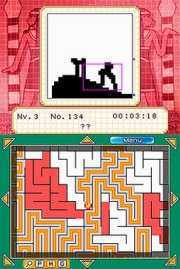 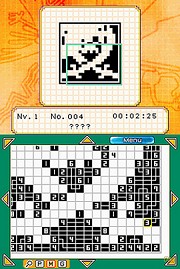 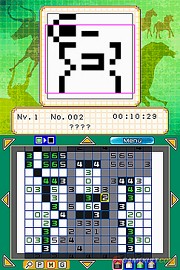
Maze Paint , Drawing and Magipix, in that order.
PIC PIC (505 Games)
One of the few great Japanese puzzlers that HAS been released in
the West, this wonderful game came out some time ago and has been
mentioned on WoS before, but if you missed it and you own a DS, you
really need to prick up your ears round about now, because it's the
best thing since Slitherlink. Comprising three entirely different
puzzle games in one, any of which would justify a release on its
own, Pic Pic offers a stunning 1200 individual puzzles to work
through, with challenge levels for every occasion. The three types
of game in themselves have very distinct difficulty gradings - Maze
Paint, which does exactly what it says on the tin, charges you
simply with finding your way through a maze, using the stylus or
d-pad. As you go, your trail forms a picture on the upper screen
(making pictures being the three puzzle types' obvious link), and
it's a great game for kids (on the earlier stages), or when you want
a time-killer that won't give you a headache from too much
brain-strain.
Moving up a step brings you to
Drawing, which is WoS' favourite by far of the three styles. You're
presented with a grid full of pairs of numbers, which you have to
link by lines. The number of squares connecting each pair is the
number written on them (including the two end squares, so if you
have two "8" blocks there'll be six blank spaces between them), and
you have to draw a line of that length - see the right-hand
screenshot above for an illustration of how it works. It starts off
very easy, with small grids and small numbers and obvious paths, but
by the halfway point you'll be finding "16" and "17" blocks all over
the place in 40x40 grids requiring tortuous, twisted links (with the
numbers in different colours to give you a fighting chance), and the
satisfaction of knocking one of those off is huge. More importantly,
though, because each grid is effectively broken down into lots and
lots of little local minigrids, you're nearly always only thinking
about two or three individual links at a time, so you never feel
hopelessly overwhelmed and every Drawing puzzle is actually fun
while you're solving it.
For hardcore puzzle experts, the third
game type, Magipix, is the real contest. You're faced with a white
grid containing numbers from 0 to 9, signifying the number of
squares in the 3x3 block surrounding the number which ought to be
filled in black (so if you see a "9", for example, you know that
that square and every one touching it need to be black), and that's
all the help you get, apart from the digits lighting up in green
when they have the right number of surrounding squares filled
in (but not necessarily the correct ones). You have to deduce from
the arrangement of numbers which specific squares have to be filled
so that every number is correct, and from very early on it's
murderously difficult. The game quickly stops handing you the 9s and
0s that can be locked in immediately, and you'll frequently find
yourself helplessly staring at the screen and weeping as you try to
calculate multiple levels of possibilities in your head at once just
in order to try to fill in a single square with certainty. It's a
lot like a visual version of Sudoku in that respect, and a lot less
directly enjoyable in mid-puzzle than Drawing is, but when you solve
one and the picture finally reveals itself on the upper screen, it's
so rewarding that you'll want to go out and buy yourself a new car.
|
TO READ THE REST OF THIS FEATURE
(3,179 words), BECOME A
WoS SUBSCRIBER |
|